
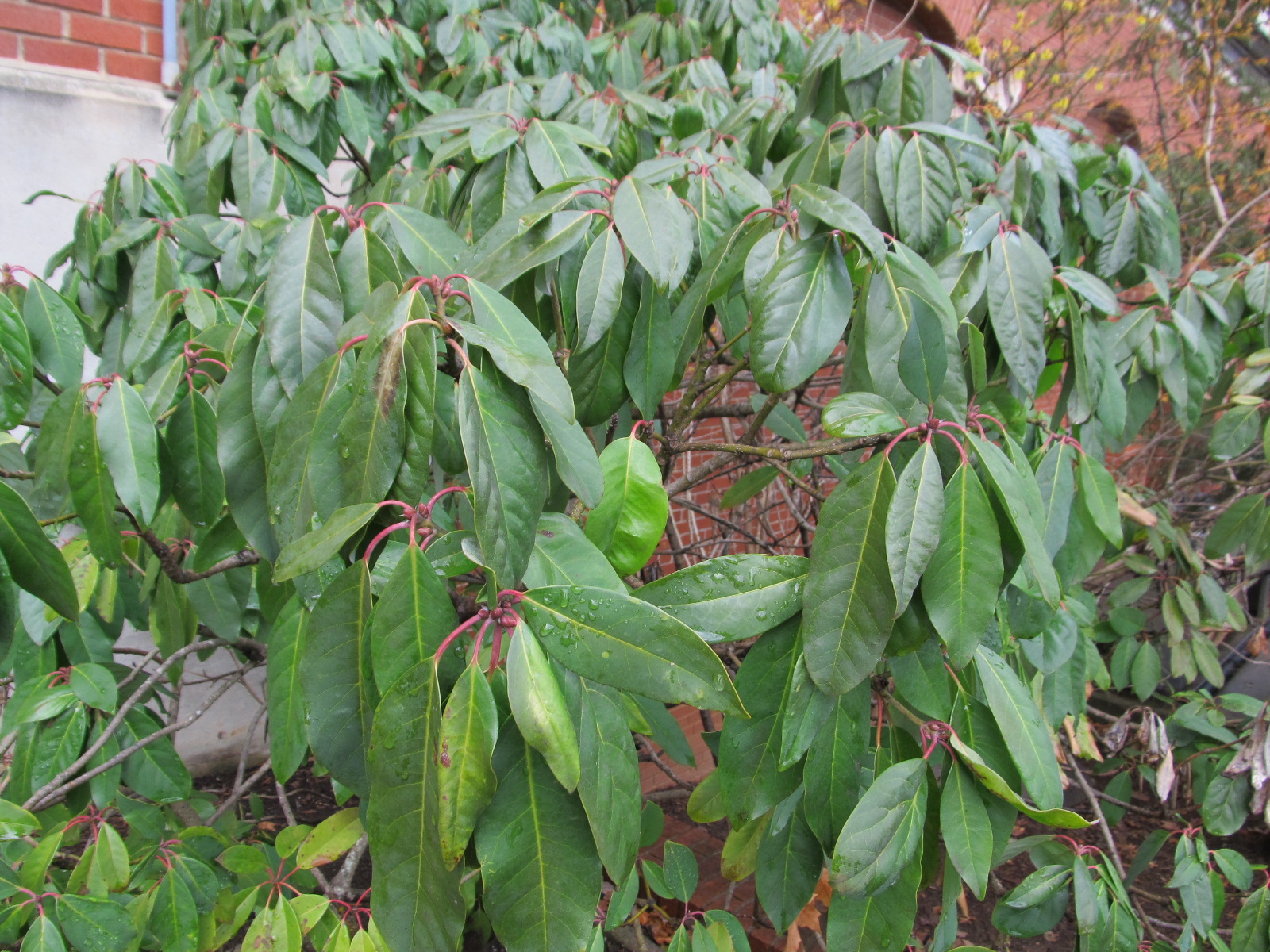
Daphniphyllum macropodium is a rounded understory broadleaf evergreen shrub or small tree native to forested lands in Japan, Korea and China. Daphniphyllum, aka “false daphne”, is recognized for its attractive foliage and unique flowering habit. It stands out for its bold rhododendron-like leaveage. It typically grows to 15-25 feet tall in cultivation; add on 5-10 feet if plant is growing in its happy place.
Long-petioled, oblong to oblanceolate, leathery leaves, 5-10 inches long by 1-3 inches wide, are arranged in closely spaced spirals at the stem ends similar to the leaves on some rhododendrons. Very prominent are its showy purplish red petioles. The deeply glossy deep leaves above and a glaucous light green beneath are outstanding.
Daphniphyllum is dioecious, either male or female on individual shrubs/trees. Flowers are mostly inconspicuous. Female shrubs bear blue ellipsoid fruits on numerous rachis that radiate from under the whorled leaves. In May-June non-showy apetalous flowers in axillary racemes bloom from the leaf axils on previous year’s growth. Male flowers are purple-pink and female flowers are pale green. Female flowers, once pollenized and fertilized, give way to ellipsoidal blue-black drupe fruits (to 1/3” long). Male shrubs/trees do not produce fruit.
Winter hardy to USDA Zones 7-9, daphniphyllum is best grown in moist, rich, sandy-humus-rich, slightly acidic, well-drained soils in part shade. Shrubs may survive Zone 6 winters if sited in a sheltered location and mulched in winter. The soil should be kept uniformly moist, particularly when grown on full sun sites where leaf scorch may be a potential problem. Propagation is mostly by seed.
Unfortunately, much of the ellipsoid-shaped fruits are hidden within the foliage; the brick-red fruits are quite showy. Over a cold winter night, leaves may droop down severely and fully recover by late the following morning. This climatic response is called “epinasty”. Dapniphyllum foliage is attractive in decorative seasonal arrangements.
This humongous shrub might serve as a great tall shady screen on large properties. No disease and pest problems have been reported to date. Leaf scorch may occur in full sun. Deer tend to mostly avoid daphniphyllum. Utilize as a single specimen or plant several in groups if fruit and viable seed are desired).
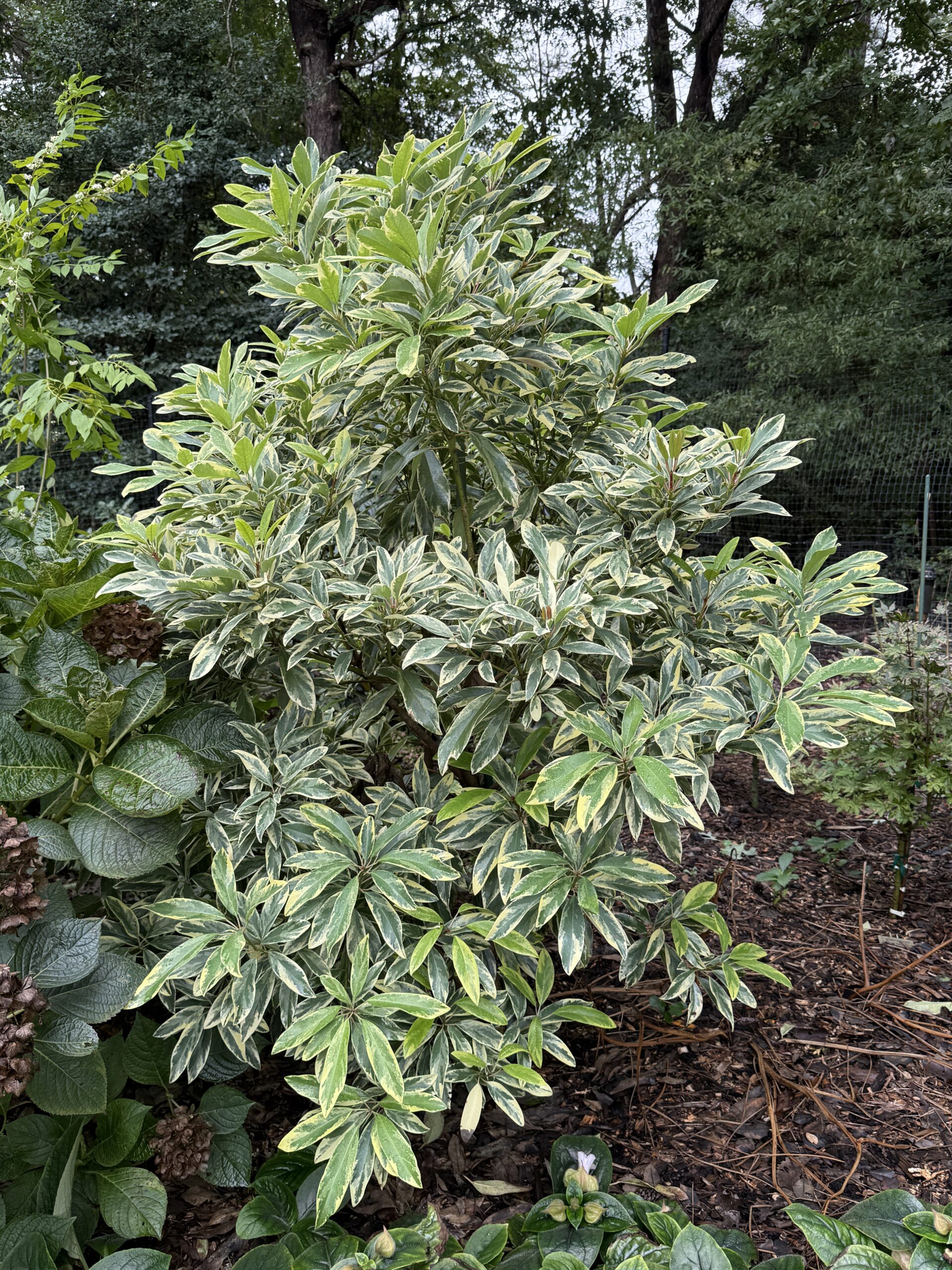
Plant availability is mostly limited to e-nurseries online. The variegated leaf form (pictured above) is produced in very small numbers.
 Posted in


