
Over the past few years a flower bed containing cosmos (Cosmos bipinnatus) has become a rare sight across the Southern Appalachian region (USDA zones 6 and 7). Not so, at the recently visited BuGa National Gardening Show 2011 in Koblenz, Germany. Called by some “Mexican asters”, cosmos produces big 3- inch wide red, white, pink […]
Archive for the ‘watering tips’ Category
Invite Sonata Cosmos Into Flower Beds
Posted by Hugh on July 7th, 2011
 Posted in Disease resistant, Flowers, Southern Appalachian Region, Summer flowering, Summer heat tolerant, watering tips
  Comments Off on Invite Sonata Cosmos Into Flower Beds
Tough And Reliable Chinese Astilbes
Posted by Hugh on July 4th, 2011
Astilbes (also called “false spireas”) are favorite late spring flowering perennials. The Astilbe x arendsii hybrids from Germany are most popular and available at local garden centers. Astilbes are very hardy in the Southern Appalachian region (USDA zones 6 and 7). If low maintenance is your goal, try Chinese astilbe (Astilbe chinensis var tacquetii). Their […]
Posted in Astilbe (false spirea), Flowers, Perennials, Southern Appalachian Region, Spring flowering, Summer flowering, watering tips Comments Off on Tough And Reliable Chinese AstilbesFlaming ‘Fireball’ Hibiscus Quite A Summer Show
Posted by Hugh on June 18th, 2011
‘Fireball’ hibiscus (Hibiscus x moscheutos ‘Fireball’) is a vigorous hardy perennial with burgundy tinted cutleaf foliage and huge 10-12 inch clear red flowers from mid-summer to late summer. Plant height is 4 – 5 feet and 2 – 3 feet in width. A strikingly beautiful plant, ‘Fireball’ thrives on heat and humidity. It wants full […]
Posted in compost, Flowers, Hardy hibiscus, Hibiscus moscheutos, Perennials, plant nutrition, Southern Appalachian Region, Summer flowering, watering tips Comments Off on Flaming ‘Fireball’ Hibiscus Quite A Summer ShowCalliope™ Dark Red Geranium- One of the Best
Posted by Hugh on June 4th, 2011
Garden performance is very important. Calliope™ Dark Red geraniums have it!! Calliope geraniums are interspecific hybrids with zonal-type leaves and huge vibrant red flowers. Plant breeders crossed ivy geraniums (the kind commonly used as hanging baskets) and zonal geraniums (found growing in pots, window boxes, and as bedding plants). Calliope is a vigorous grower with a mounding to semi-trailing […]
Posted in Autumn flowering, deadheading, Fertilizing plants, Flowers, Geranium, Southern Appalachian Region, Spring flowering, Summer flowering, Summer heat tolerant, Uncategorized, watering tips Comments Off on Calliope™ Dark Red Geranium- One of the BestSummer Wine™: The Taming of The Ninebark
Posted by Hugh on May 19th, 2011
Over the past 25 years our native Eastern ninebark (Physocarpus opulifolius) has been reborn. Its overly vigorous nature has been tamed. Latest up is Summer Wine™ ninebark with small, deeply cut, wine burgundy leaves, quite different from the medium green foliage of old-fashioned ninebarks. Summer Wine is a more compact (5-6 feet in height and width) grower. Grow ninebark in […]
Posted in compact shrub, container shrub, Ninebark, Southern Appalachian Region, Spring flowering, Trees & Shrubs, watering tips, Winter Garden Interest, winter hardiness Comments Off on Summer Wine™: The Taming of The NinebarkStop Ignoring Enkianthus
Posted by Hugh on May 7th, 2011
From the photo, looks like a pieris? No, it’s redveined enkianthus (Enkianthus campanulatus) and its brightly colored bell-shaped flowers are attention getters in the early May garden. Lovely cream yellow to orangy red bell shaped flowers are faintly red veined. The bell shaped blooms exude a slight scent, one that you may like or not. From the start, growth rate […]
Posted in acidic soil, compost, Enkianthus, Southern Appalachian Region, Trees & Shrubs, watering tips Comments Off on Stop Ignoring Enkianthus“Mary, Mary, How You Do Grow in My Garden”
Posted by Hugh on May 4th, 2011
‘My Mary’ is a hybrid deciduous azalea (R. ‘Nacoochee’ x R. austrinum) ending its flowering cycle in my spring garden. ‘My Mary’ has been a steady performer, averaging 4-5 feet in height in 10 years. Its clusters of bright yellow orange tubular flowers measure 2 1/2” across. Its early morning sweet fragrance is a gentle […]
Posted in acidify soil, Azalea (deciduous), compost, Deciduous Azaleas, Fertilizing plants, mulching, Southern Appalachian Region, Summer heat tolerant, Trees & Shrubs, Uncategorized, watering tips, Winter Protection Comments Off on “Mary, Mary, How You Do Grow in My Garden”Wolfeyes Chinese Dogwood
Posted by Hugh on April 20th, 2011
Chinese dogwood (Cornus kousa), a favored spring-flowering tree, reaches 20-25 feet in height and blooms two weeks subsequent to our native flowering dogwood (C. florida). The ‘Wolf Eyes’ cultivar forms a compact tree or large shrub, standing 8–10 feet tall and nearly twice as wide. lowly reaches 10 to 20 ft. tall and wide; largest […]
Posted in acidic soil, Attracting birds, Bees and other pollinators, Chinese (kousa) dogwood, compact tree, Disease resistant, Disease resistant, Landscape ideas, Light requirement, mulching, Non-native, Propagation(grafting), Purchasing Plants, Soil drainage, Southern Appalachian Region, Summer heat tolerant, Trees & Shrubs, watering tips, winter hardiness Comments Off on Wolfeyes Chinese Dogwood‘Misty Blue’ Doll’s Eye Will Catch Your Eye
Posted by Hugh on March 22nd, 2011
White baneberry or doll’s eye (Actaea pachypoda) is a strikingly beautiful native perennial. The cultivar ‘Misty Blue’ was first discovered at Mt. Cuba Center in Greenville, Delaware. The bluish-green foliage is multi-stemmed and finely cut from mid-spring thru the summer months. Grow it in a moist shade garden environment. Lovely fringed white flowers appear in April. In the fall clusters of white “doll’s eye” berry fruits sit atop brightly red […]
Posted in acidic soil, Baneberry (Actaea), compost, Garden Maintenance, Native Plant, Perennials, Southern Appalachian Region, watering tips Comments Off on ‘Misty Blue’ Doll’s Eye Will Catch Your EyePulmonarias: Wonderful In The Shade Garden
Posted by Hugh on March 6th, 2011
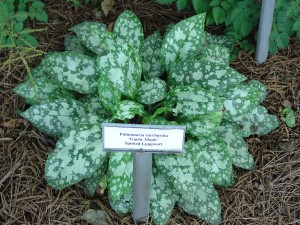
Although my multi-year addiction for hostas has never waned, I remain equally passionate about the lungworts (Pulmonaria spp.). Lungwort is also called Bethlehem sage and Jerusalem sage. Their uniquely splotched or variegated foliage wakes up a dark patch in any shade garden. Lungworts are planted as ground covers and for color accents. In early spring (March), lungworts send up […]
Posted in acidic soil, Container garden, Ground cover, Landscape ideas, mulching, Perennials, Planting tips, Propagation (dividing), Pulmonaria, Purchasing Plants, Shade Gardening, Soil drainage, Southern Appalachian Region, Spring flowering, Sun scald, watering tips, winter hardiness Comments Off on Pulmonarias: Wonderful In The Shade Garden


