
Japanese pieris (Pieris japonica) offers a year-round show in a garden with evergreen foliage and showy bell-shaped blooms (USDA hardiness zones 5- 8). New spring foliage starts out bronze-colored and matures to dark green. Attractive, pendulous branches if ivory white flower appears in early spring. Remnants of the old seed heads generally persist into the […]
Archive for the ‘Flowering’ Category
Start Spring Out with Easy To Grow Japanese Pieris
Posted by Hugh on March 12th, 2014
 Posted in acidic soil, Bee Favorite, compact shrub, Evergreen, Flowering, Pieris japonica, Planting tips, Pruning, Southern Appalachian Region, Spring flowering, Trees & Shrubs, watering tips, winter hardiness
  Comments Off on Start Spring Out with Easy To Grow Japanese Pieris
Small (Dwarf) Crape Myrtles Becoming The Vogue
Posted by Hugh on July 27th, 2013
‘Tightwad Red’ Crape Myrtle Over the past quarter century crape myrtles (Lagerstroemia spp.) have become the quintessential flowering shrubs of summer along with hydrangeas (Hydrangea spp.), altheas (Hibiscus syriacus), and chaste tree (Vitex agnus-castus). Crape myrtles are grouped into four distinct size categories: trees, large shrubs, medium shrubs and dwarf sizes. A spate of new dwarf […]
Posted in acidic soil, alkaline soil, Bee Favorite, Butterflies, compact shrub, Crape myrtle (Lagerstroemia), Disease resistant, Drought tolerant, Fertilizing plants, Flowering, Heat Tolerance, mulching, plant nutrition, Planting tips, Pruning, Southern Appalachian Region, Summer flowering, Trees & Shrubs, Uncategorized, watering tips Comments Off on Small (Dwarf) Crape Myrtles Becoming The Vogue‘Sunburst’ Golden St. John’s Wort
Posted by Hugh on July 16th, 2012
Our native golden St. John’s wort (Hypericum frondosum) deserves more planting space in U. S. gardens (USDA hardiness zones 5-8). ‘Sunburst’ is the leading cultivar and exhibits superior traits over the species. Golden St. John’s wort forms a small, dense growing deciduous shrub, noted for its showy golden yellow flowers and attractive blue-green foliage. Sunburst grows more compact […]
Posted in acidic soil, alkaline soil, Butterflies, compact shrub, Disease resistant, Drought tolerant, Evergreens, Flowering, Heat Tolerance, Native Plant, Ornamental fruit, Pruning, Soil drainage, Southern Appalachian Region, Spring flowering, St. John's Wort (Hypericum), Summer flowering, Summer heat tolerant, Winter bark Comments Off on ‘Sunburst’ Golden St. John’s WortTree and Berry Fruit Pollination Chart
Posted by Hugh on February 3rd, 2012
A frequent question of newbie fruit gardeners is what will pollinate what. Do I need many varieties or can all be the same variety? The four common terms are used: Self-pollinated: transfer of pollen occurs within the same variety. Cross-pollinated: transfer of pollen occurs between two varieties. Self-unfruitful: low fruit set unless the blossoms […]
Posted in apple orchard, Apple tree, Bee Favorite, Blueberries, Elderberry (Sambucus), Flowering, Fruits & Vegetables, Grapes, Peach, Pear (Pyrus spp.), Plum, Pollination needs, Raspberries, Spring flowering, Strawberries, Uncategorized Comments Off on Tree and Berry Fruit Pollination ChartAutumn Colors Conclude with Callery Pears
Posted by Hugh on November 23rd, 2011
Callery pear (Pyrus calleryana) has been declining in planting popularity. But its scarlet red leaf color is both sensational and reliable every autumn in the Southern Appalachian region (USDA zones 6 and 7). Most people identify the tree by its cultivar name, e.g. ‘Bradford’, Aristocrat®, ‘Cleveland Select’, ‘Redspire’ pear. There are many other cultivars. Callery pears are tough reliable medium sized trees which […]
Posted in Attracting birds, Bee Favorite, Bradford Pear, Drought tolerant, Fertilizing plants, Flowering, Heat Tolerance, Pruning, Soil drainage, Southern Appalachian Region, Spring flowering, Summer heat tolerant, winter hardiness Comments Off on Autumn Colors Conclude with Callery PearsSummer Blooming Oyama Magnolia
Posted by Hugh on July 10th, 2011
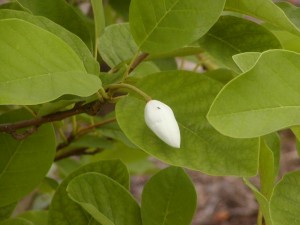
A friend on vacation sent me the attached photo from Wooster, Ohio. When I told him that it was Oyama magnolia (Magnolia sieboldii), he asked why gardeners are not growing it. Good question! Oyama magnolia is a 10-15 feet tall (and equal spread) deciduous tree or large shrub from eastern Asia. It prefers to grow […]
Posted in acidic soil, compost, Featured, Flowering, Large shrub, Magnolia, Magnolia sieboldii, mulching, Propagation (Cuttings), Pruning, Southern Appalachian Region, Spring flowering, Summer flowering, winter hardiness Comments Off on Summer Blooming Oyama MagnoliaDouble Take™ Flowering Quinces
Posted by Hugh on April 8th, 2011
Photo credit: Dr. Tom Ranney, NCSU Research Horticulturist Flowering quince (Chaenomeles spp) is an early spring flowering shrub, treasured for its brightly colored blooms (USDA hardiness zones 5-9). Old fashioned quince shrubs produced small amounts of fruits which were gathered and prepared into yummy jelly in the autumn kitchen. These often large 10-12 foot tall shrubs produced small sharp […]
Posted in Bee Favorite, compact shrub, Fertilizing plants, Flowering, Flowering quince (Chaenomeles), Propagation (Cuttings), Soil drainage, Spring flowering, Summer heat tolerant, Trees & Shrubs, winter hardiness Comments Off on Double Take™ Flowering Quinces‘Kintoki’ Japanese Cornel Is Perfect Fit for Small Urban Gardens
Posted by Hugh on February 27th, 2011
‘Kintoki’ summer foliage It’s a dogwood and comes close to being a plant that offers four seasons of landsape beauty. Kintoki Japanese cornel (Cornus officinalis ‘Kintoki’) is a special semi-dwarf 10-12 foot tall dogwood which fits into most small gardens. Kintoki’s bright yellow flowers open in early March in the Southern Appalachian region (USDA zones 6 and 7). […]
Posted in compact tree, Flowering, Japanese cornel, Southern Appalachian Region, Trees & Shrubs, winter flowering tree Comments Off on ‘Kintoki’ Japanese Cornel Is Perfect Fit for Small Urban Gardens‘Sunsphere’ Japanese Cornel
Posted by Hugh on February 24th, 2011
Japanese cornel (Cornus officinalis) is a tall shrub or small tree dogwood which matures to 20-25 feet in height and 15 feet in width. ‘Sunsphere’ Japanese cornel was discovered by Mike Stansberry, owner of Beaver Creek Nursery in Knoxville, TN. Japanese cornel is the official start of spring in my garden, even though the calendar reads late […]
Posted in Disease resistant, Flowering, Southern Appalachian Region, Trees & Shrubs  Tags: 'World's Fair cornelian cherry Comments Off on ‘Sunsphere’ Japanese Cornel
Edgeworthia Deserves A Try
Posted by Hugh on February 21st, 2011
Edgeworthia flowering in March garden First, I must thank South Carolina nurseryman, Mr. Ted Stephens, who gifted me a Chinese paperbush (Edgeworthia chrysantha) nearly 6 years ago. Most plant authorities rate its winter hardiness to USDA zones 7 and 8. It struggled through its first winter and spring in my zone 6-b garden, but has never disappointed. […]
Posted in compact shrub, Disease resistant, Edgeworthia, Flowering, Southern Appalachian Region, Trees & Shrubs, Winter Protection Tags: Edgeworthia Comments Off on Edgeworthia Deserves A Try


