Sugar Maple Is A Four Star Autumn Attraction

Sugar maple autumn color

Spring flowering

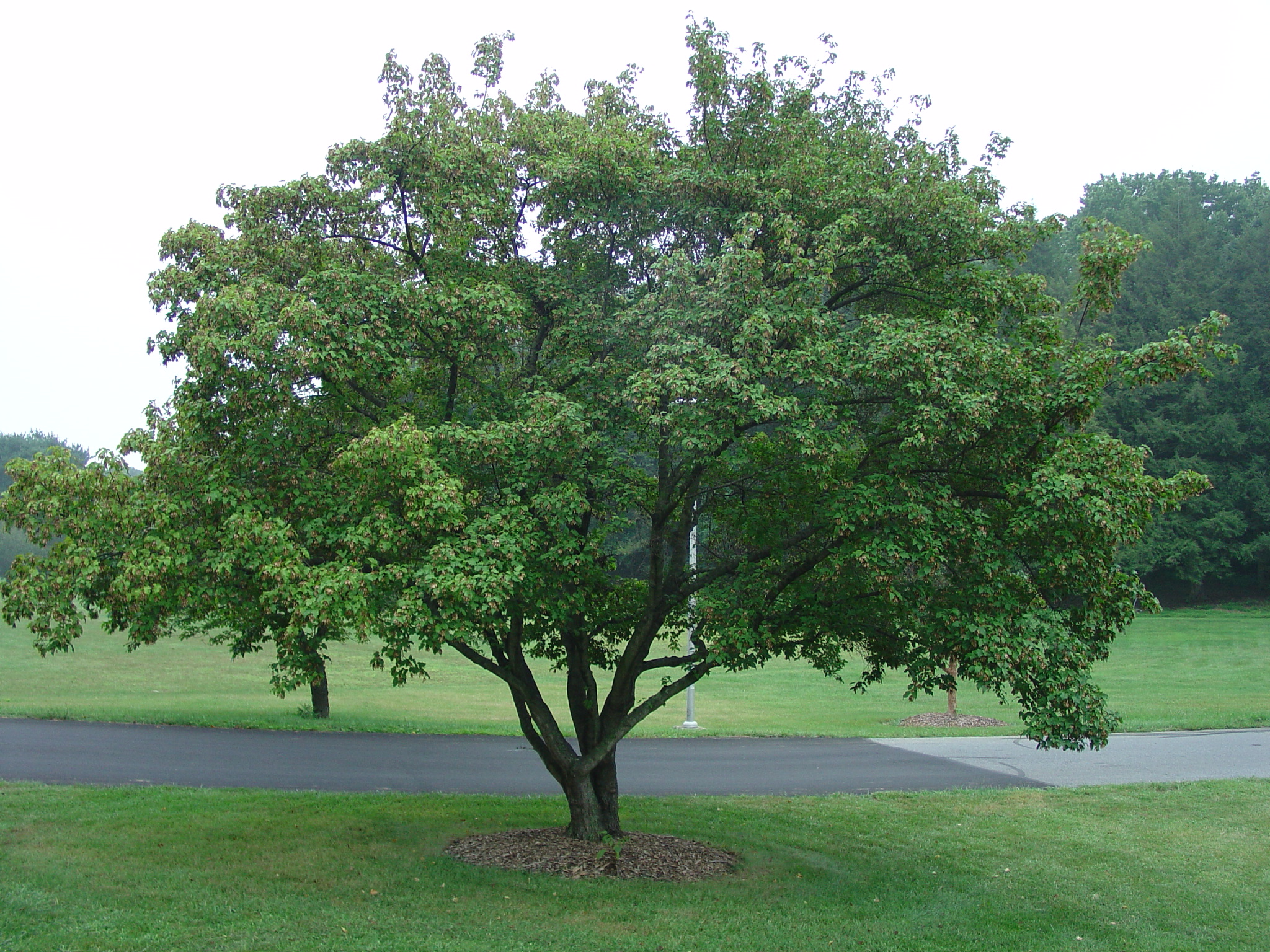
Sugar maple (Acer saccharum) is a native deciduous tree often planted as a large shade or street tree. It commonly grows 60 to 75 feet (and taller) with a dense rounded foliage canopy. Native to central and eastern North America regions, sugar maple grows best in fertile, mildly acidic, moist well-drained soils and in full sun to part shade.

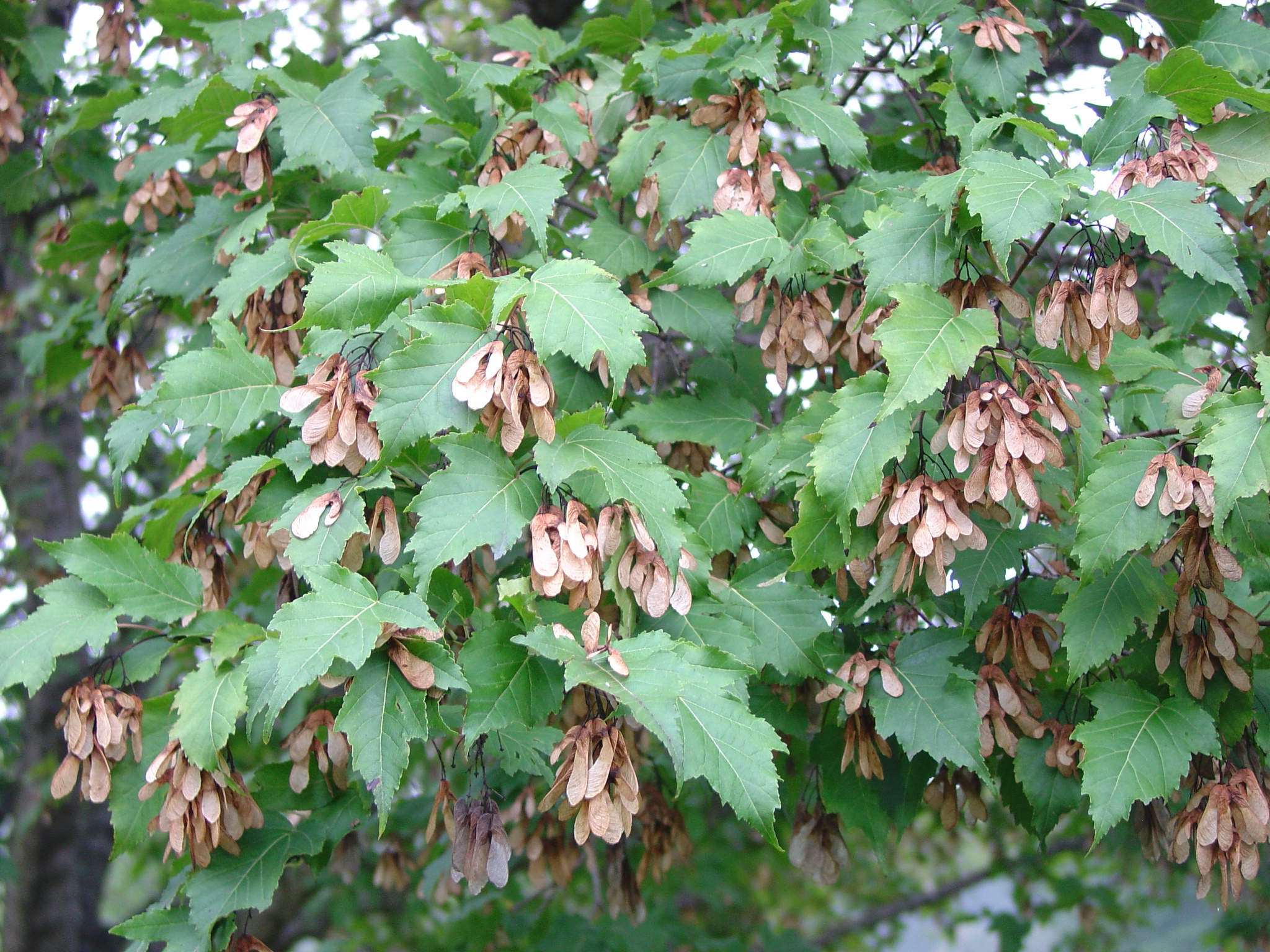
The 5-lobed deep green leaves of summer takes on yellow, orange and red shades in the autumn. Clusters of yellowish-green flowers appear in mid-spring a week before the leaves emerge. Flowers ripen into clustered pairs of double-winged samaras (or “helicopters”) in late summer. In the winter tree trunks may be tapped for maple syrup (“saccharum” means sugar).

Disease and pest problems are less when properly sited and maintained. Do not plant in dry compacted sites such as in downtown parking lots or as street trees. Poor locations bring on numerous serious diseases and insects, including verticillium and fusarium wilts, leaf spots, cankers, wood borers and scale. Its shallow roots raise up urban sidewalks.There are more than 25 sugar maple cultivars, and here are three exceptional ones.

‘Green Mountain’ has broadly pyramidal tree form. The foliage may struggle in summer heat and dry periods, causing leaf edges to brown (scorch). However, its thick deep green foliage is resistant to leaf hoppers and scorch, making it an ok choice as a street tree.

‘Legacy’ sugar is a more heat and drought resistant, making it a good pick for the southeastern U.S. The tree canopy is densely branched and has glossy thick green leaves. The leaves turn yellow to orange in autumn.

‘Green Column’ (A. saccharum subsp. Nigrum), aka black maple, exhibits better than average heat and drought resistances. Summer foliage is dark green and is thick and leathery to the touch. It develops a yellow fall color that’s two weeks later than other sugar maples.

Fall Blooming ‘Little Suzy’ American witchhazel


Hamamelis virginiana 'Little Suzie' in October '12

Little Suzy American witchhazel (Hamamelis virginiana ‘Little Suzy’) was hybridized and introduced by Harald Neubauer, owner of Hidden Hollow Nursery in Belvidere, TN. This medium sized shrub grows 8-10 feet tall and 10-15 feet wide. It is particularly suited to small urban gardens where standard American witchhazels (20-25 feet in height and width) are too large. Little Suzy’s short compact nature is due to its shorter internode lengths.

Little Suzy blooms freely at a young age. The witchhazel-scented soft yellow blooms appear in October and November in the Southern Appalachian region (USDA hardiness zones 6 and 7). The 4- narrow, strap-shaped yellow petals appear at a time of year when little else is blooming.

New leaves emerge reddish-bronze in early spring and turn dark green. Summer leaves are dark green and remain blemish-free from disease and pest woes. Foliage stays clean and pest-free throughout the growing season. The 3 to 6 inch long coarsely toothed leaves turn clear yellow before falling in late autumn.

American witchhazel is not finicky where it grows, either in full sun to partial shade. It prefers moist, acidic, and well drained soil, but a 2-year established shrub exhibits good heat and drought tolerances. Their “popcorn” like seed capsules can disperse  seeds 25 feet or more away.

American witchhazel is utilized as a fall blooming oddity or plant several together for a deciduous hedge or privacy screen. Through judicious pruning a shrub can be shaped into a lovely small tree.

Little Suzy witchhazel is available from specialty plant nurseries on-line.

American Elm Is Back

American elm in woodsy landscape near Knoxville, TN

American elm (Ulmus americana) once lined America’s city streets until the deadly Dutch elm disease (DED) mostly eliminated it. DED is still present today. Outstanding disease resistant cultivars are truly making a difference, and American elm is on the comeback.

American elm is native to the eastern and central regions of the U. S. and southern Canada (USDA hardiness zones 3 to 9). American elm are related to hackberry (Celtis spp.) and zelkova (Zelkova spp.). There are many species of elm worldwide. Its arching vase shape branching habit is its trademark trait, and this large tree averages 60 to 80 feet in mature height and 25-30 feet in width.

Compared to other landscape trees, American elm is one of the earliest to flower, often in late winter in the Southern Appalachian region (USDA hardiness zones 6 and 7). By late May flowers have set small circular winged seeds (samaras) which float by wind over long distances. Seeds germinate rapidly under favorable conditions.

American elm grows in moist deep soils and full to partial sunlight.  It copes with dry average soils, is mostly soil pH insensitive, and tolerates high soil salt levels better than most tree species. Elm withstands brief flooding episodes in spring and fall. Prune elm from mid-summer into fall when potential pest problems are minimal and the internal sap flow is low.

The first line of defense against Dutch elm disease is planting resistant cultivars. American elm is also susceptible to deadly phloem necrosis disease, with symptoms similar to Dutch elm. Elms are subject to numerous insect pests, but rarely threaten their long time survival.

Among the best resistant cultivars with true American elm bloodline, ‘New Harmony’, ‘Valley Forge’, ‘Washington’, and ‘Jefferson’ stand out. Among the Asian – American elm hybrids, ‘Morton’ (Accolade™) is a recommended choice. Accolade elm is also resistant to elm leaf beetle feeding.

Blue Mist (Caryopteris) Sparkles in Late Summer Garden

Caryopteris x clandodensis

Blue mist spirea or bluebeard (Caryopteris x clandodensis) is not commonly planted in U.S. landscapes. In mid- to late- summer, pale blue flowers open above the gray-green foliage. Leaves and stems are mildly aromatic to the touch.  There are now several good hybrid forms, thanks to plant breeders’ efforts to improve garden performance.

Caryopteris (I prefer this name) grows in average soil, preferably slightly acidic, and wants very little extra care. Although moderately drought tolerant, don’t allow it to suffer through a prolonged dry spell without irrigation. Cold hardy to USDA hardiness zone 5 (perhaps 4 with some protection), branch tips may die back 30-40% over winter.

Some plant experts classify caryopteris as a hardy perennial and treat it as such. Shoot injury may become noticeable in early spring, necessitating pruning. The easiest solution is to severely prune back the entire shrub in late winter. 

This shrub recovers rapidly from cutting back. The technique is simple, not time saving, and doesn’t require reading a pruning book. It results in a compact growing, space-saving shrub.

Caryopteris may open hundreds of blooms at any time over a 6-8 week period from late summer into fall. Caryopteris suffers from very few disease and pest problems, including deer feeding.

Its flowers and gray-green foliage (select varieties) are prized by florists who utilized them in fresh and dried flower arrangements. Fresh keeping quality often lasts 7 days and longer. 

Many hybrid cultivars are available, including two favorites:

     ‘Worcester Gold’ – solid gold foliage and pale blue flowers.

     ‘Dark Knight’ – deep blue flowers on 3-4 foot compact plant.

Variegated Solomon’s Seal Designated 2013 Perennial Plant of the Year

Variegated Solomon's Seal in Virginia Tech's Hahn Gardens in Blacksburg

Variegated Solomon’s seal ( Polygonatum odoratum ‘Variegatum’) is one of the finest perennials for the shade or woodland garden. It is the Asian cousin of U.S. native Solomon seal (P. commutatum). Both species are long- lived garden inhabitants.

Variegated Solomon’s Seal handles 2-3 hours of direct morning sunlight in the Southern Appalachian region (USDA hardiness zones 6 and 7) if the soil is kept evenly moist. It grows 18 to 24 inches high and 3 to 4 feet wide in 10 years. As a groundcover it is not overly aggressive, so plan on 4-5 years for it to nicely colonize. It possesses good drought tolerance after a two year establishment interval.

Its creamy white bell-like flowers appear in spring  under each leaf axil. The pleasantly fragrant lily-like flowers lightly scent the early evening air in the late April and May garden.  

Its gently arching variegated foliage is its key landscape appeal. The 3-4 inch long olive green leaves are daintly edged in white. In the fall, the white margins turn pale yellow with the greenish hues persisting to mid- autumn. Foliage and stems die off naturally in late autumn requiring little cleanup.

Plant variegated Solomon’s Seal under the shade of large shrubs and trees in a moist, richly composted, well- drained woodland soil. Plant with other companion shade loving plants such as ferns, hostas, hardy ginger (Asarum), toadlily (Tricyrtis spp.), brunnera (Brunnera macrophylla), et al.

Disease and pest issues are rare. Slugs may be problematic if wet weather persists or plants are frequently irrigated overhead.

‘Autumnalis’ Is Good Flowering Cherry, Perhaps Over-hyped

Fall Blooming 'Autumnalis' Cherry

Autumnalis cherry (Prunus x subhirtella ‘Autumnalis’) is a long-lived, fast growing flowering cherry. This variety of higan cherry grows to medium size, 20-40 feet in height and 15-30 feet in spread.

Autumnalis produces a heavy bloom of semi-double pink flowers in spring and again, in sparse numbers in autumn (mid-October) in the Southern Appalachian region (USDA hardiness zones 6 and 7). Fall flowering trait is often over-hyped, equal to perhaps 5-8% of spring flower numbers. 

Fruits and fall foliage color add little ornamental landscape value. Pea sized black fruits ripen in early autumn and attract numerous birds who feed on the tiny morsels. Autumn foliage turns greenish yellow before abcising.

Higan cherry grows best  in full to partial (6 hours minimum) sunlight and in well-drained soils. It is exceptionally heat and cold hardy in the Southern Appalachian region (USDA zones 6 and 7). Compared to many cherries (Prunus spp.), Higan cherry is resistant to most serious disease problems. 

Be forewarned that Japanese beetles and tent caterpillars may devour summer foliage unless protected with the proper pesticides. Trunk and branch wood is typically reddish brown, covered with raised horizontal lines called “lenticels”. Gardeners often confuse lenticels for scale insects.

Take Redtip Photinia Off Your Planting List

Mid-April Flowering of Photinia

Some 30-40 years ago redtip photinia (Photinia x fraseri) was commonly planted as a broadleaf evergreen hedge in the Southeast U.S. (USDA hardiness zones 6 -8).  This dense growing 15 foot tall and wide shrub sports firey red new leaves in spring and summer. The red leaf tint fades to green within a few weeks.

Many homeowners desire a  fast growing evergreen shrub when planting a hedge or screen between their neighbors and redtip photinia delivers. Its white flowers were not foul-smelling as other photinia species.

Photinias are great plants in many areas of the U.S., but not in the humid Northeast and Southeastern U.S. Redtip photinia is highly susceptible to Entomosporium leaf spot, a fungal disease. An almost weekly preventative spray program to protect the plant foliage all season long becomes costly and impractical.

Not all photinias are disease prone. Chinese photinia (P. serrulata) is leaf spot resistant. It grows taller at 20 feet in height and width, but lacks the red foliage color. Its flowers emit a foul odor in late March/early April.  Japanese photinia (P. glabra) is similar in shrub size and shape to redtip. Its  spring foliage color is bright red and blooms almost two weeks later in mid-April. However, Japanese photinia is susceptible to leaf spot.

Photinias handle average well-drained soils in full or partial sunlight. Planted in heavy shade, foliage density is less and more prone to disease. Overhead watering in dry summer periods results in higher disease outbreaks. Hedge or prune photinias in late winter or late summer when not actively growing.

Some alternative broadleaf evergreen shrubs include hollies (Ilex), cherry laurels (Prunus), gold dust shrubs (Aucuba), euonymus, mahonias, and nandinas.

Pignut Hickory: What’s In A Name

Lovely Golden Yellow Fall Color of Pignut Hickory

Pignut hickory (Carya glabra) is a medium to large tree that you may fortunately inherit when purchasing property. Pignut deserves a better name like “smooth bark hickory”. The species is commonly found in upland forests.

Pignut hickory prefers fertile well-drained soil and in full sun to partial shade. A young seedling trees start off slowly from a large taproot. This also makes most hickory species difficult to transplant.  

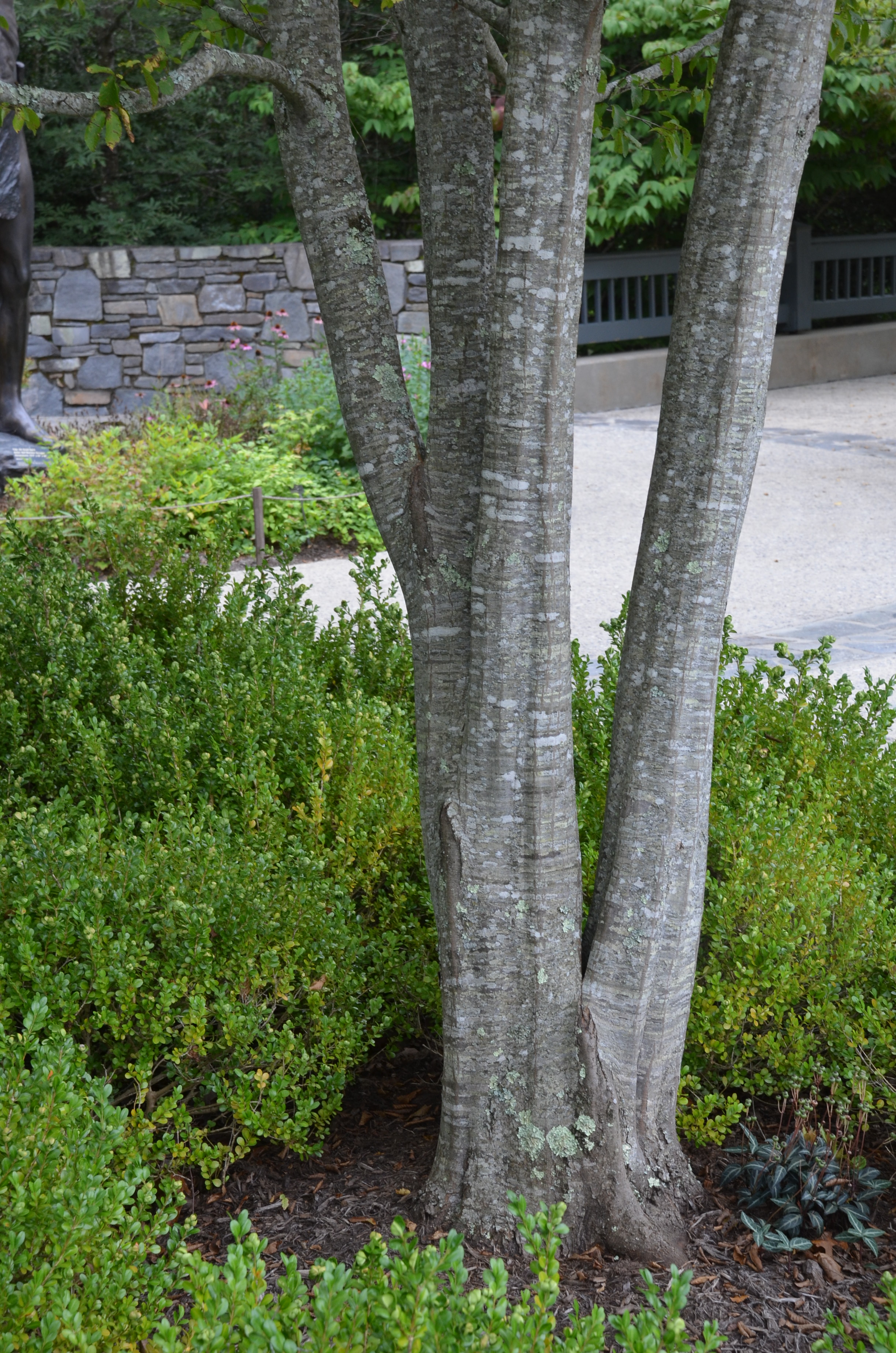
Pignut hickory grows 50 to 60 feet high by 25 to 35 feet wide, consisting of a long straight trunk, ascending vase-shaped branching, and rounded canopy. The furrowed bark on the trunk is gray to grayish-brown which becomes moderately rough with age.

The alternate pinnately compound leaves are 8 to 12 inches long , commonly 5 leaflets, sometimes 7. The medium green summer foliage turns deep golden yellow color in the fall. Short drooping male catkins flowers appear in mid to late April in the Southern Appalachian region (USDA zones 6 and 7). Trees produce large 1½ to 2 inch long nuts which are bitter tasting. Many small mammals rely on the pignut hickory for food and shelter.

The wood is valued in furniture-making and in barbequing to capture the hickory flavor. While disease and pest problems are rarely serious, a number of butterfly larvae feed on its dense compound foliage in late summer.

Minor Bulbs Get A Jump On Spring

Snowdrop (Galanthus) in early March

Companion bulbs, often called “minor bulbs”, are early signs that spring is coming. Three of the most reliable are snowdrops, winter aconites and Glory of the snow. They bloom before crocus.

Winter aconite (Eranthis hyemalis) returns with floral beauty less than three months after planting. Plants poke through the ground, grow and flower 3 to 6 inches high and wide. Bright yellow cup-shaped flowers appear in mid- to late winter. Green leaves emerge as the flowers begin to fade. All evidence of their presence disappears by late spring, when the bulbs go dormant.

Pure white, nodding, bell-like snowdrops (Galanthus nivalis) often peak through the winter snow in February. Leafless 3-4 inch stems support individual flowers. Plants grow only 4-6 inches high with 2-3 strap-like leaves.

Glory-of-the-Snow (Chionodoxa forbesii) is so-named because, in northerly areas, their bright blue six-petalled flowers poke up through the snow in the winter. Bulbs and seeds often spread very aggressively.

Bulbs are planted 3-4 inches apart and 2-4 inches deep in the fall. Sow in large numbers for maximum flowering impact under trees and shrub and in perennial beds. They should receive full day winter sunlight. All three companion bulbs are critter proof, not bothered by deer and voles. All are hardy in USDA hardiness zones 3–7. They often naturalize and the planting can last a lifetime.

All companion bulbs prefer compost-rich soil that is well-drained and moderately moist. Before planting pre-soak the bulbs overnight to hasten germination.

Snowdrops, winter aconites, and Glory of the snow are native to southern and eastern Europe.

Winter aconite (Eranthis)

Emerald Ash Borer And Others Are Spreading – Don’t Transport Firewood


Stack of Firewood

Moving firewood across county or state lines may also distribute serious insect pests hundreds of miles. For whatever reasons that the tree(s) were cut down in your yard, insects (including termites) may be hiding inside the logs. They may remain alive for a long time.

Over the past decade three serious exotic insect pests have been identified – emerald ash borer, Asian longhorn beetle, and walnut twig beetle. These insects continue to destroy stands of native trees in our forests and street/park trees in our urban areas. The firewood you cut down (or purchase) should not be transported miles away. Properly dispose of the wood where you live.

These three exotic pests and others are killing commercial timber acreage. Since their discovery quarantines forbidding the movement of specific wood products, such as firewood, have been established. However, the quarantine areas continue to expand every year. Legal shipping of logs via interstate highways is being checked. Camping sites, including those around major recreational or gathering areas are being inspected. This includes tailgate parties at NASCAR and football events.

Monitoring and control efforts for emerald ash borer, walnut twig beetle and other invasive pests continue. Please do your part in controlling the spread of these tree-killing pests by purchasing firewood at local campsites rather than transporting your own.