Growing Spuria Iris Worth The Challenge


photos courtesy of Iris City Gardens

Jimmy Turner, Dallas Arboretum horticultural guru, gave me this idea. Growing spuria iris in the Southern Appalachian region can be quite challenging. Hardy to USDA zone 5, spurias are dormant (asleep) during our usually hot, dry summers. A wet summer is a real “downer” for spurias.
Spuria irises bloom two weeks after the popular tall beard iris. They grow and flower best under full sun. Spurias are not choosy about soil type and pH. Bloom stalks can reach 4+ feet in height in a good garden soil.
Foliage dries up in the heat of summer, very natural for spuria iris. Gardeners should not attempt to revive them with irrigation. Autumn showers revive plants. Once growth re-starts, plants hate to dry out.
Spurias need one year to become established. Space plants at least 3 feet apart. Divide them every 5 years. Natural rainfall in our region is usually plentiful. The easiest way to kill spurias is to mulch and overwater them.
You may purchase spurias from several mail order nurseries or local nurseries which specialize in iris. Personal shopping emporiums include Iris City Gardens in Nashville, TN and Heritage Gardens in Greeneville, TN.

Time to Plant Early Vegetables

Photo credited to University of Illinois Extension

Spring weather seems to have finally arrived here in the Southern Appalachian region. While the weather has changed for the better. Night time temps have remained above 30° F over the past 8-9 days. Spring frosts in the morning are common in this region into early May. More snow showers will likely occur, so it is wise not to stow away the snow shovel just yet.
St. Patrick’s Day (March 17) signals the traditional start for planting early veggies, called the cole crops, within USDA zones 6-b to 7a. Night temps in the mid-20’s are unlikely to injure these cool season vegetables.

Why the early start? Well-rooted young plants in March better cope with the warm 70°F days ahead in April and May. Poorly established vegetables like cabbage, broccoli and cauliflower get “heat stroke” on hot days and likely will bolt (go to seed).

Plant your greens – lettuce, mustard, spinach, chard and kale. Turnips provide both greens and edible roots. Root vegetables such as carrots, potatoes and radishes are part of the early spring agenda.

For carrots to develop well, they require a loose, friable soil. Most of us garden in a tight, clay soil. I advise planting carrots in a raised bed, mixing generous amounts of compost into your soil, creating a porous and deep-rooting grow medium.

Re-blooming Amaryllis — Just Add Water

An amaryllis bulb is nature’s equivalent of a re-chargeable battery. In the fall stop watering to push the bulb into dormancy (sleep). Most leaves wither and die within 4-6 weeks. Remove a dried leaves (for neatness). The bulb must remain dormant for a minimum of 8 weeks. Store the pot anywhere, in a closet shelf or out in the garage, provided the storage temperature does not drop below freezing (32° F).
Every few weeks, restart a potted amaryllis bulb. Place in an east or south-facing window of your home, and add water. Pre-mix a water-soluble fertilizer in the water according to manufacturer’s directions. First watering requires that you sink the pot bottom in a pail of water/fertilizer for 2-3 hours to fully adsorb water and nutrients. Turn the pot weekly so the plant and flower stalk grows straight up.
Your amaryllis will bloom in 4-6 weeks. Enjoy it! After flowering, continue to water and feed the plant until it can be moved outside onto a sunny deck or patio in mid to late spring after the frost danger has past. Your amaryllis will flourish through the summer months and will be fully recharge by autumn.
Repot your amaryllis every 3-4 years in the fall after dry-down. Divide and give away the extra bulbs to garden friends to enjoy. I enjoy shopping for new amaryllis bulbs at local garden shops and on-line at http://www.brentandbeckysbulbs.com/

“Pruning Cuts –Avoiding the Big Ones”

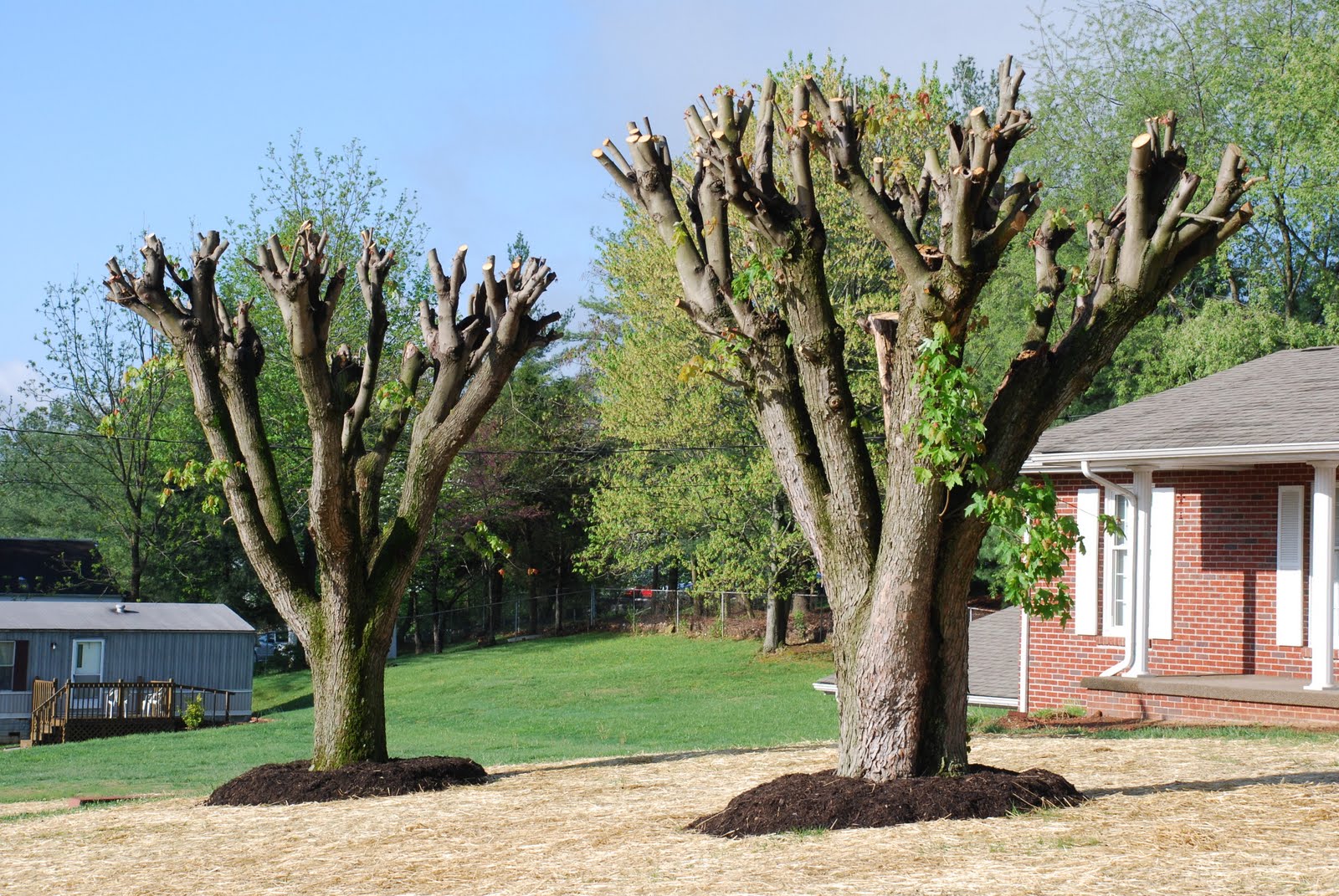
Question: was this pruning cut a mistake? You judge.
Driving home yesterday, I spied upon this extreme pruning cut (see photo). The tree pruner may have read the chapter in the pruning manual about cutting a damaged or broken limb on an angle to shed snow and rain. Had he/she missed the chapter that recommends making the smallest possible cut? This cut is very large.

Whenever possible, make small cuts and on a 30°- 45° angle. I have the advantage of seeing the oak tree up close. In this case, tree pruner may have experienced extenuating circumstances. I had not seen the extent of injury to this storm damaged tree. I’ve concluded that this tree cut is correct.

Each pruning cut is a wound. A small cut heals more rapidly than a wide cut. Cutting on an angle is correct, creating the smallest possible diameter wound. There is no need to apply a tree wound paint or sealant. These products are simply cosmetic.

Prune most trees and shrubs in late winter unless they flower in spring. If you delay, spring-flowering plants may be pruned within one month after blooming. Prune summer-flowering shrubs and trees in late February and March because their flowers are initiated on new spring -summer growth.

Aucuba — Major Shade Garden Shrub

Gold Dust Shrub (Aucuba)

On a recent trip to the Knoxville Botanical Garden, I was re-introduced to a plant not used as much as it should be – gold dust shrub (Aucuba japonica). Hardy to USDA hardiness zones 6b-10, aucuba prefers a partial sun to heavy shaded area of the garden. Direct sunlight, even in the mostly cloudy winter may scorch some leaves.

Over the past 20 years I have grown a “plain green” foliage variety in my northeast Tennessee garden. The 7-8 foot shrub is tucked in among three Japanese maples. Its holly-like leaves and bright red berries become more noticeable after the surrounding maples have surrender their fall foliage.

Several gold and white speckled cultivars sparkle in an otherwise dreary winter garden. I particularly like ‘Picturata’, exhibiting large bright golden specks over the leaf center and splashed by tinier yellow dots. Aucuba is diecious, meaning the red fruits are borne on a female plant.
 
Branches on this 8-10 foot tall shrub are upright in habit. Growing needs are similar to hollies (Ilex spp.) – preferring a well-drained, richly composted and moist soil. Gold dust is pruned mostly to shape and limit plant height. Two year established shrubs demonstrate exceptional heat and drought tolerance.

Japanese Apricot Blooms in Winter

Japanese apricot (Prunus mume) is a beautiful reminder that the worst of winter may be behind us. On days barely above freezing, the light pink fragrant blossoms open, rarely in great numbers. Cold nights freeze the blossoms but other buds will open during the next warmup.

Japanese apricot is cold hardy in garden zones 5 thru 7. It is a small 10-12 foot tree, rarely bearing fruit. Plant in a full sun area of the garden, near decks and patios where you can visually enjoy the winter bloom from inside your warm home. The tree is likely to coax you outside.

Japanese apricot does not prosper in hot or dry locations. Plant in a moist, well-drained soil, mulch when needed, and prune to maintain an open branched tree. Over a dozen cultivars are available in white, pink, or red tones and single, semi-double or double blossoms.

‘Cassata’ -Not Your Typical Daffodil

photo by Susan C. Morgan, Horticultural Manager at the Dallas Arboretum

I found this among my daughter Susan’s Facebook photos: Narcissus ‘Cassata’. Cassata is her favorite daffodil -bar none.
The creamy white flower of ‘Cassata’ is a unique bright yellow split corona (cup) which matures to white. The reflexed “petals” from the split cup are ruffled and lie almost flat against the rear white petals.
Cassata blooms early to mid- spring among other narcissus. Plant size is 16 to 18″ tall.
Bulbs will naturalize in USDA Zones 4 to 8.

Cassata is for sale in the fall catalog of Brent and Becky’s Bulbs, a mail-order bulb emporium in Gloucester, VA. Check them out on thewebsite: http://www.brentandbeckysbulbs.com/

‘Bosque’ Lacebark Elm – a Better Choice

New planting of ‘Allee’ elm

Ulmus parvifolia ‘Athena’ at NC Arboretum in Asheville, NC

Recent storm damage has caused a re-evaluation, whether to continue to plant the cultivar Allee®, also called ‘Emerald Vase’. Urban foresters around the state of Tennessee report that limb breakage and clean up around Allee elms is greater than around other cultivars. Bosque seemed to fare much better.

Lacebark elm (Ulmus parvifolia) is a beautiful medium -sized street and shade tree. Its use in urban street plantings has become popular over the past decade. The three leading cultivars of lacebark elm are Allee®, Athena® and Bosque™.
The tree earns its name from the delightful orange or brown color mosaic or puzzle-like pattern over the main trunk (s) and branches. The autumn leaf color is rarely memorable and the small 1-2 inch leaves fall without much fanfare and leaf litter mess.
Get lacebark elm off to a long and prosperous life by supplying extra water and light fertilize feeding the first two years. In the first two years after planting, a young tree needs deep watering every two weeks in the late spring and summer. An established lacebark elm exhibits exceptional drought tolerance.
If you or your city or town is planting lacebark elm in your housing subdivision, ask a certified arborist in your area which lacebark elm cultivars grow best for your area.

Tips on Planting an Apple Orchard

Apples are easy to grow with a little planning. Select the varieties based on what you like to munch on. Visit the local supermarket and buy several to sample. Some apples taste better in pies and in sauce. Some varieties have a short shelf life and must be consumed within a few weeks after picking or purchase. Favorites like ‘Granny Smith’ and ‘Rome’ are good for eating, baking pies and making sauce.
How long are you willing to wait? Apple trees grafted on seedling rootstocks begin bearing fruit in 7-8 years. Varieties grafted to dwarf (grow 9 feet tall) or semi-dwarf (12-15 feet tall) rootstocks begin bearing a crop within 3 years.

Young trees should be allowed to grow and never permitted to bear fruit. Space semi-dwarf trees 15-18 feet apart and dwarf trees at least 8-10 feet apart. Plant two or more different varieties for adequate cross pollination.
Plant trees either in late winter (before spring) or in the autumn in an open sunny site. Mulch trees to 2- 3″ depth with a minimum 18 inches diameter around each tree trunk. In late fall pull mulch away and loosely wrap the tree trunk to a 2 foot height (add another foot if you live in heavy snow zone) with hardware wire (cloth) to prevent rabbits and pine voles (mice) from chewing on the tender sugary bark of a young fruit tree.
Finally, order trees early and request delivery before the first day of spring.
Check with your local Extension agent or agricultural university for additional information about growing apples.
Popular apple varieties:
Gala-yellow-orange to red /fresh/early
Empire -dark red over green background/ fresh, cooking/ early
Red Delicious -red/fresh/early midseason
Jonagold-yellow with light red stripes /fresh, cooking /midseason
Golden Delicious-yellow green to light yellow/fresh, cooking /midseason
Fuji -green with red stripes/fresh /late midseason
Stayman-blush to red /fresh, cooking/late
Rome-blush to red /fresh, cooking /late
Granny Smith -greenish-yellow/fresh,cooking/late

U.S. Native Viburnums And Viburnum Beetle Susceptibility

photo -Arrowwood viburnum in late summer

A trip to Carolina Native Plants Nursery in Burnsville, NC gave me this idea to list those viburnums which are U.S. natives (USDA Hardiness zones 6 and 7). All are worthy for planting in your landscape in full sun except where noted. All attract birds and other wildlife to your property.
  • Mapleleaf vibrnum (V. acerifolium) – prefers dry shade sites
  • Witherod viburnum (V. cassinoides)
  • Arrowwood viburnum (V. dentatum) – hardy north into zone 3
  • Sheepberry, nannyberry (V. lentago) -hardy north to zone 3
  • Smooth witherod viburnum (V. nudum)- superior cultivar ‘Winterthur’
  • Small viburnum (V. obovatum)
  • Black haw viburnum (V. prunifolium) -in part shade areas
  • Rusty blackhaw (V. rufidulum)
  • American cranberrybush (V. trilobum)- try cultivar ‘Wentworth’, which is hardy to zone 2

Superior cultivars of arrowwood viburnum is currently available and are utilized as a 5-7 foot deciduous screen or hedge. For woodland plantings blackhaw and maple-leaf viburnums are at home in shady areas.

According to Cornell University entomologists, most native viburnums are susceptible to viburnum beetles. This serious pest can be managed by timely applications of horticultural oils, spinosad (organic pesticide), and insecticidal soaps in late April and early May, targeting hatching eggs and young larvae which feed on the new tender foliage. Insecticides containing pyrethrins are effective, but also will kill beneficial insects in the garden.