Princess Lilies — Hardy in Zone 6

Not all alstroemerias are alike. I have been enjoying my Princess lilies (alstroemeria hybrids from Holland) over the past 6 years. They have been surprisingly winter hardy in zone 6-b where I garden. Further south in zones 7 and 8, Princess lilies prefer part sun to partial shade.

I grow’em on the east side of the garden in full sun. The harsh afternoon sun of summer is filtered through the tall shrubs and trees nearby. Mulching the soil provides extra freeze protection to roots in the winter and guarantees their return next spring.

Princess lilies need little care after planting. I feed’em a handful of granular 10-10-10 around each plant in late winter. Give them a weekly irrigation for 1/2 hour or more during summer dry spells. Plants grow short and compact and are also suitable for containers on the deck or patio.

Currently, there are 17 varieties, richly colored in whites, yellows, pinks and reds. This spring I will be adding 1 or 2 new Princess lilies to the perennial flower border .

‘Sky Pencil Holly vs ‘Dee Runk’ Boxwood

‘Sky Pencil’ holly at Saunders Brothers Nursery in Virginia

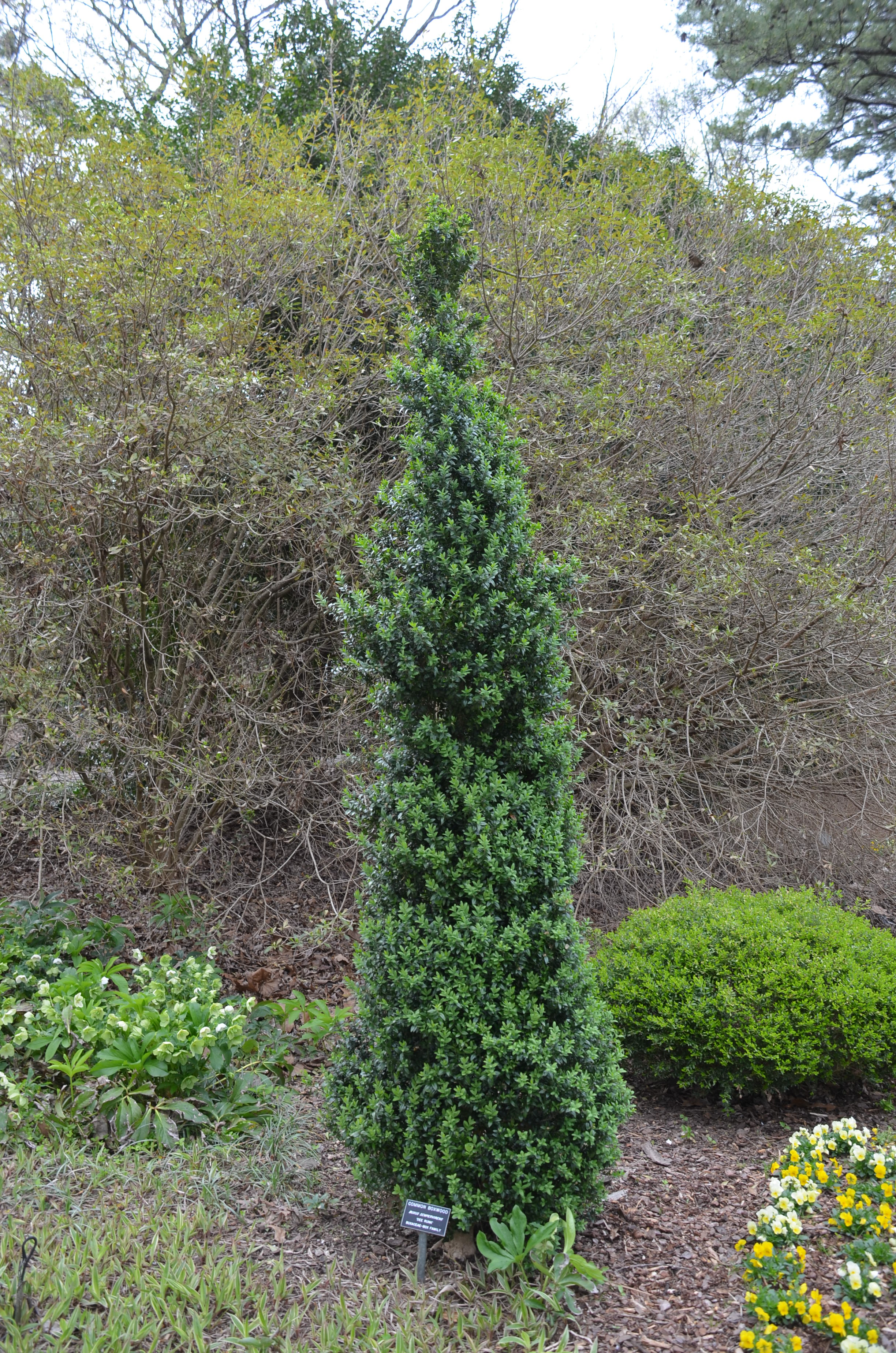
‘Dee Runk’ boxwood

Boxwoods and hollies are mainline evergreen shrubs, utilized for low hedging, privacy barriers. Single shrubs are planted solely for their architectural accent.  Both hollies and boxwoods grow best in moist, well-drained soils and in full sun to partial shade.  Both prefer soils with a pH of slightly acidic to slightly alkaline. Boxwoods tend to be more shade tolerant than Japanese hollies. In winter plant foliage may scorch or bronze if grown in open sun.

Plants are generally tolerant of pruning and shearing. Pruning too early in spring may promote tender new growth that is easily injured or killed by a late spring frost.
There are few shrubs that fit into narrow spaces better than ‘Dee Runk’ boxwood (Buxus sempervirens ‘Dee Runk’). Research has shown that Dee Runk is a better choice than currently popular cultivar ‘Graham Blandy’, which is seriously troubled by soil borne diseases, specifically Phytophthora root rot.
‘Sky Pencil’ Japanese holly (Ilex crenata ‘Sky Pencil’) exhibits a similar upright (fastigiate) form. They are finicky regarding soil drainage. Plants are particularly susceptible to soil root rot diseases including Phytophthora and Pythium.
Both ‘Dee Runk’ boxwood and ‘Sky Pencil’ holly grow well in large landscape containers on patios and along downtown streets in USDA zones 6-9. Expect mature shrub heights between 8-10 feet.

Planting Leyland Cypress May Be Big Mistake

If you live in USDA Plant Zone 6-b – 7, planting leyland cypress (x Cupressocyparis leylandii) could eventually turn into a maintenance diseaster in your landscape. Leyland cypress is a green behemoth, too fast and aggressive for most folks to handle. Ask yourself, “do you really need a 60-70 foot evergreen privacy screen around your property?” If neighbors can’t view in, you can’t see out.

 
Many gardeners make the mistake of planting leyland cypress only 6-8 foot apart. Leyland demands a wider 16-18 foot spacing. Unfortunately, leyland is also susceptible to 3 fungal needle blight diseases. Diseases usually don’t infect until shrubs are 10 years and older. There are no practical cures (pesticides) for these diseases. Over time the shrubs may need to be removed at a considerable cost to you.
 
If you must grow tall screens or hedges, I recommend the more dependable Japanese cedar (Cryptomeria japonica) or Green Giant arborvitae (Thuja x plicata). In the 20-25 foot height category, plant Nellie R. Stevens holly, Foster#2 holly and Emerald arborvitae (Thuja occidentalis ‘Smaragd’).
 
 
Some great evergreen choices in the 10-15 foot range are leatherleaf viburnum (Viburnum rhytidophyllum), skip laurel (Prunus laurocerasus ‘Schipkaensis’) and ‘Hick’s Yew (Taxus x media ‘Hicksii’).

Beware of Storm Damaged Trees


This past weekend Northeast Tennessee as well as most of the coastal eastern U.S. was hit by heavy snow, 7 inches and more of heavy, wet clinging snow. Many of my neighbors lost electric power, telephone and cable.
A driveby survey of tree damage around the neighborhood found that the following tree species suffered the most breakage (in order of severity):

  • Chinese (Siberian) elm
  • Silver maple
  • White pine
  • Weeping cherry (pictured)
  • Topped trees
  • Bradford (callery) pear
  • Red maple
  • Dead or dying trees
  • Sycamore (London planetree)
  • Southern magnolia
  • Sweetbay magnolia
  • Yoshino cherry
  • Dogwood

The type of injury ranged from large falling limbs two inches or more in diameter (Chinese elm, white pine, and silver and red maples) to many small branches less than one inch diameter (weeping cherry. magnolias and dogwoods).

Lessons learned:

  1. Select a tree species that is reliably storm resistant. Expect some limb breakage on any tree species, but fast growing trees like Chinese elms and silver and red maples, and those that are not properly maintained, suffer the most damage. When homeowners properly prune landscape trees every 5 years, storm damage is considerably less.
  2. Old mature trees, which have outlived their expected life span, should be removed and replanted with younger specimens. For example, Chinese elm, silver maple and white pine reach full maturity within 40 years. Bradford pear has a short replacement time of 15 years. Pruning maintenance on all landscape trees should be every 5-7 years.
  3. Topped trees suffered considerable limb losses as the weakened re-growth is exceptionally susceptible to breakage. The topping of trees is never a recommended practice. In my opinion, if a large tree threatens your home, personal property or utility lines, either seek care advice from a professional arborist or have the tree removed by a licensed and bonded arborist.
  4. Previously dead or dying trees pose a bigger hazard during in a storm.

Keep Your Pansy Faces Smiling

Success in blooming pansies and violas in the winter season depends on two key factors: date of fall planting and soil nutrition. If you live in USDA plant zone 6, pansies must be planted on or before October 15th, two weeks earlier in northerly zone 5, or two weeks later in zone 7. Early fall planting promotes faster and deeper rooting of plants before the cold weather arrives.

Through the fall and winter months, pansies need feeding bi-monthly with 10-10-10 or equivalent granular fertilizer to achieve maximum bloom potential.

Regarding transplant shock, violas violas are less effected compared to large  flower pansies. Small flowered violas take up less garden space; therefore, the plants are spaced closer together compared to large flowered pansies. Thus, you will need to purchase more violas that pansies. Violas and small flowered pansies are more weather resilient compared to varieties with larger bloom faces like ‘Majestic Giant’ and ‘Mammoth’ series.

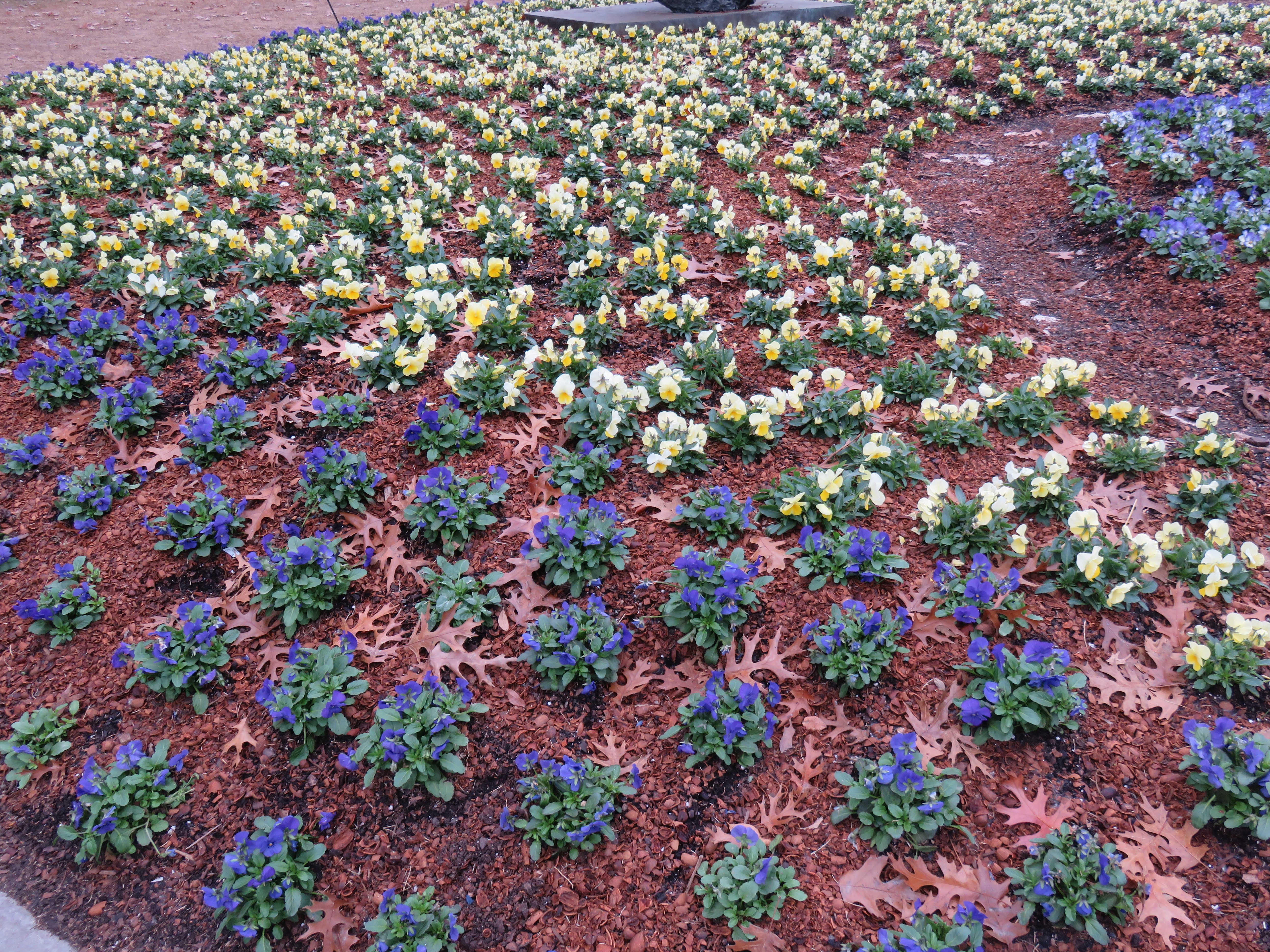
Pansy planting at Dallas Arboretum in December


Other ideas using pansies:

Offer pansy/viola plants a weekly drink of water, particularly in he winter if rain or snowfall in your regional area is low.

In areas where winters are colder (zone 4), apply a straw or pine needle mulch after planting to protect pansies.

In the fall consider interplanting tulip or hyacinth bulbs among the pansies or violas.

Warm weather in mid-May will stretch pansies plants and make them appear “worn out”. Remove pansies and add plants to the compost pile. Add finished compost to the flower bed before setting summer annuals.

Baptisia – 2010 Perennial Plant of the Year

Blue false indigo(Baptisia australis) is a beautiful, long-lived, drought tolerant perennial with a robust growth habit and attractive steel blue foliage. In late May, the violet-blue flower spikes rise tall above sturdy 3-4 feet tall plants with steel bluish-green foliage.
Baptisias grow best in full sun and in moist, well-drained soils. Feed or fertilize baptisias sparingly to prevent plants from flopping over.  If grown in full sun, no staking is necessary. Plants are heat and drought tolerant and are rarely troubled by diseases and insects.

Baptisia australis was selected Perennial Plant Of The Year in 2010 by the Perennial Plant Association.  Other species of Baptisias include lavender blue (B. minor), white (B. alba), bright yellow (B. sphaerocarpa) and bicolors bloom from May into early June (in Tennessee). Modern day cultivars are usually hybrids. Each species or cultivar will bloom for 2-3 weeks.

Plants grown in partial shade may appear stretched or leggy, often requiring staking. Fewer flower spikes are produced in shady places. The only maintenance that I perform is removing thee pea -like pods that form within a month after flowering. I feel the pods detract from the clean shrub-like appearance of baptisias. In late fall I cut plants down to the ground and add all vegetation to a compost bin.

The single plant spreads slowly by rhizomes and eventually crowds out neighboring plants. Divide a plant clump every 5 -6 years and share divisions with gardening friends or start new plantings. It can be used in fresh flower arrangements.


Surprise lily (Lycorus)

Surprise lily or resurrection flower (Lycorus radiata) should be ordered in January because of limited available supply. Divisions are shipped fresh dug in June for immediate planting. Flowers emerge in late July and August. Lycorus is long-lived garden perennials, hardy in USDA hardiness zones 6-b thru 9. In the past I have ordered mine from Brent and Becky’s Bulbs on-line.

Dogwoods for Spring

‘Appalachian Snow’ dogwood

Five disease resistant varieties of  flowering dogwood (Cornus florida), released by the University of Tennessee in Knoxville, are available at local garden centers this spring. Supply should be better than in past years.

Powdery mildew resistant varieties: ‘Appalachian Snow’ (pictured), ‘Appalachian Blush’ and ‘Appalachian Mist’. In addition, ‘Cherokee Brave’, with dark pink flowers,  exhibits good mildew resistance.

‘Cherokee Brave’ dogwood

Anthracnose resistant variety: ‘Appalachian Spring’

Poet’s laurel-great shade garden shrub

Alexandrian laurel or poet’s laurel (Danae racemosa) is a lovely 2-4 foot, low arching, evergreen shrub. It thrives in shady areas of the garden, spreading slowly from root suckers. Poet’s laurel stays in its intended place and does not overwhelm other plants around it. Tiny greenish-white flowers appear in late spring and are often overlooked. By early fall the ½- inch round berries turn bright orange-red and persist to year’s end. Poet’s laurel prefers a moist well-drained soil in the shade garden. You can cut its glossy waxy-green foliage for indoor floral arrangements.

Hardy Forms of Deodara Cedar

I am surprised by the increasing numbers of deodara cedars (Cedrus deodara) that are prospering in Zones 6-b and 7 gardens. Apparently, deodara cedars are much hardier than once thought. The buzz at a recent American Conifer Regional meeting is these varieties list here are worthy of planting:

Tree forms:

  • ‘Karl Fuchs’
  • ‘Shalimar’
  • ‘Eisregen’
  • ‘Eiswinter’
  • ‘Polar Ice’

Shrub forms:

  • ‘Feelin Blue’
  • ‘Glacier Blue’ (photo)
  • ‘Divinely Blue’
  • ‘Snow Sprite’
  • ‘Cream Puff’
  • ‘Aurea’

Deodara cedars grow in deep, moist, well-drained, acidic loams in full sun. D-cedars are intolerant of poorly drained wet soils. D-cedars are very drought tolerant once established. I urge providing some protection around young plants from drying winter winds until they become established after two years. Add and maintain 3-4 inches of  an organic mulch around newly planted cedars. Fertilize annually in early spring with a slow release product such as Osmocote™ or Nutrikote™.