
Garden performance is very important. Calliope™ Dark Red geraniums have it!! Calliope geraniums are interspecific hybrids with zonal-type leaves and huge vibrant red flowers. Plant breeders crossed ivy geraniums (the kind commonly used as hanging baskets) and zonal geraniums (found growing in pots, window boxes, and as bedding plants). Calliope is a vigorous grower with a mounding to semi-trailing […]
Archive for the ‘Spring flowering’ Category
Calliope™ Dark Red Geranium- One of the Best
Posted by Hugh on June 4th, 2011
 Posted in Autumn flowering, deadheading, Fertilizing plants, Flowers, Geranium, Southern Appalachian Region, Spring flowering, Summer flowering, Summer heat tolerant, Uncategorized, watering tips
  Comments Off on Calliope™ Dark Red Geranium- One of the Best
Wild Epaulette Tree Can Be Tamed
Posted by Hugh on May 26th, 2011
Epaulette tree (Pterostyrax hispida) is a small flowering tree which quickly grows to a mature height of 20—25 feet. Winter hardiness here in the Southern Appalachian region (USDA zones 6 and 7) is no problem. A newly planted tree grows an average of 15-18 inches per year and blooms early. Epaulette prospers in a moist well-drained […]
Posted in Disease resistant, Epaulette tree (Pterostyrax hispida), Flowers, Pruning, Root suckering, Southern Appalachian Region, Spring flowering, Trees & Shrubs Comments Off on Wild Epaulette Tree Can Be TamedIs Paulownia Invasive?
Posted by Hugh on May 24th, 2011
Paulownia or Empress tree (Paulownia tomentosa) is a medium to large 30-50 foot tree. It is extremely fast growing, brittle wooded tree, as much as 4 feet per year. Across the Southern Appalachian region (USDA zones 6 and 7), the large pale violet flowers of paulownia are easily visible in May, perched on branch tips. Its […]
Posted in Invasive plant, Paulownia (Empress tree), Southern Appalachian Region, Spring flowering Comments Off on Is Paulownia Invasive?Yellowwood Not Every Year Bloomer
Posted by Hugh on May 22nd, 2011
American yellowwood (Cladrastis kentukea) is a medium-sized flowering tree. In the month of May, a beautiful yellowwood tree is in bloom somewhere in the Southern Appalachian region (USDA zone 6 and 7). The 1- 1 1/2 inch white pea blossoms comprise the 8-14 inch long wisteria-like panicles which drape from branch and twig tips. Yellowwood may bloom 2 to 3 consecutive years […]
Posted in acidic soil, Failure to Bloom, Flowers, Medium sized Tree, Native Plant, Southern Appalachian Region, Spring flowering, Trees & Shrubs, Yellowwood Comments Off on Yellowwood Not Every Year BloomerSummer Wine™: The Taming of The Ninebark
Posted by Hugh on May 19th, 2011
Over the past 25 years our native Eastern ninebark (Physocarpus opulifolius) has been reborn. Its overly vigorous nature has been tamed. Latest up is Summer Wine™ ninebark with small, deeply cut, wine burgundy leaves, quite different from the medium green foliage of old-fashioned ninebarks. Summer Wine is a more compact (5-6 feet in height and width) grower. Grow ninebark in […]
Posted in compact shrub, container shrub, Ninebark, Southern Appalachian Region, Spring flowering, Trees & Shrubs, watering tips, Winter Garden Interest, winter hardiness Comments Off on Summer Wine™: The Taming of The NinebarkA Perfect Small Garden Tree– ‘Ace of Hearts’ Redbud
Posted by Hugh on April 11th, 2011
Ace of Hearts redbud (Cercis canadensis ‘Ace of Hearts’) is an arboreal treasure, a compact form of our native redbud. Heavy clusters of light purple pea-like flowers cover twigs and branches from late March into early April, depending on your locality. Ace of Hearts grows 12 by 15 feet in height and spread, roughly one-third […]
Posted in Pruning, Redbud, Southern Appalachian Region, Spring flowering, Summer heat tolerant, Trees & Shrubs Comments Off on A Perfect Small Garden Tree– ‘Ace of Hearts’ RedbudDouble Take™ Flowering Quinces
Posted by Hugh on April 8th, 2011
Photo credit: Dr. Tom Ranney, NCSU Research Horticulturist Flowering quince (Chaenomeles spp) is an early spring flowering shrub, treasured for its brightly colored blooms (USDA hardiness zones 5-9). Old fashioned quince shrubs produced small amounts of fruits which were gathered and prepared into yummy jelly in the autumn kitchen. These often large 10-12 foot tall shrubs produced small sharp […]
Posted in Bee Favorite, compact shrub, Fertilizing plants, Flowering, Flowering quince (Chaenomeles), Propagation (Cuttings), Soil drainage, Spring flowering, Summer heat tolerant, Trees & Shrubs, winter hardiness Comments Off on Double Take™ Flowering QuincesPulmonarias: Wonderful In The Shade Garden
Posted by Hugh on March 6th, 2011
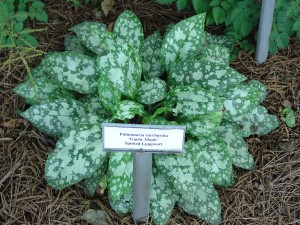
Although my multi-year addiction for hostas has never waned, I remain equally passionate about the lungworts (Pulmonaria spp.). Lungwort is also called Bethlehem sage and Jerusalem sage. Their uniquely splotched or variegated foliage wakes up a dark patch in any shade garden. Lungworts are planted as ground covers and for color accents. In early spring (March), lungworts send up […]
Posted in acidic soil, Container garden, Ground cover, Landscape ideas, mulching, Perennials, Planting tips, Propagation (dividing), Pulmonaria, Purchasing Plants, Shade Gardening, Soil drainage, Southern Appalachian Region, Spring flowering, Sun scald, watering tips, winter hardiness Comments Off on Pulmonarias: Wonderful In The Shade GardenCrabapple Shopping List
Posted by Hugh on February 10th, 2011
For those of you tired of the monotony of Bradford pears, go shopping for ornamental crabapples (Malus spp.). Most crabapple cultivars mature into long-lived small flowering trees less than 20 feet in height at maturity. Most fit under utility lines. Worldwide, there are over 400 cultivars of crabapples in nursery commerce. Most are susceptibility to […]
Posted in Attracting birds, Bees and other pollinators, Crabapple, Disease resistant, Landscape ideas, Ornamental fruit, Propagation(grafting), Pruning, Purchasing Plants, Sanitation, Southern Appalachian Region, Spring flowering, Trees & Shrubs, Winter bark, Winter Garden Interest Comments Off on Crabapple Shopping ListArkansas Bluestar Great In Spring, Summer and Fall
Posted by Hugh on October 27th, 2010
Blue star (Amsonia hubrichtii) exhibits one of nature’s finest autumn foliar displays. This Arkansas native is a long-lived perennial and prospers here in the Southern Appalachian region (USDA zones 6 and 7). After its initial year in the garden, amsonia exhibits good heat and drought tolerances. Its fine textured needle -like foliage is very soft and airy. In the […]
Posted in Disease resistant, Drought tolerant, Heat Tolerance, Perennials, Planting tips, Pruning, Spring flowering, watering tips Comments Off on Arkansas Bluestar Great In Spring, Summer and Fall


