
Many rare and unusual garden plants are introduced into a garden as a thoughtful gift. Lacebark pine (Pinus bungeana) is an arboreal aristocrat which a few gardeners are privileged to own. Lacebark is a lovely 3- needle pine with exquisite exfoliating bark which becomes more attractive each succeeding year. The lacebark feature begins after 8-10 years, but it’s […]
Archive for the ‘Fertilizing plants’ Category
Lacebark pine- an investment in the future
Posted by Hugh on December 13th, 2010
 Posted in acidic soil, Disease resistant, Drought tolerant, DWARF CONIFERS, Evergreen, Evergreens, Fertilizing plants, mulching, Pines (Pinus spp.), Planting tips, Pruning, Southern Appalachian Region, Summer heat tolerant, Trees & Shrubs, Uncategorized, watering tips, Winter bark, winter hardiness
  2 Comments »
Hardy Camellias for Southern Appalachian Region
Posted by Hugh on September 10th, 2010
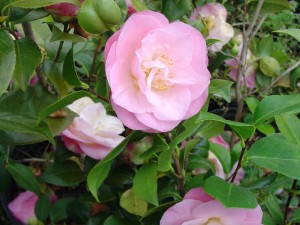
Several camellias bloom reliably either in the fall and or early spring in most areas of Tennessee within USDA hardiness zone 6. In the colder higher elevations above 2000 feet, hardy camellias require some additional shelter to successfully bloom over 6 – 8 weeks. Flower colors range from white, many shades of pink, and red. […]
Posted in acidic soil, Camellia, Evergreens, Featured, Fertilizing plants, Flowering, Regional, Southern Appalachian Region, Spring flowering, Summer heat tolerant, Trees & Shrubs, watering tips, Winter flowering  Tags: Camellia Comments Off on Hardy Camellias for Southern Appalachian Region
Culver’s Root (Veronicastrum)
Posted by Hugh on June 28th, 2010
Midwest native Culver’s root (Veronicastrum virginicum) starts the summer flowering season in my perennial garden. It naturally grows in open woods and meadows and thrives in fertile to moist soils. However, this deep rooted plant hasn’t complain about the current dry period in the Southern Appalachian region (USDA zones 6-7). Be aware that culver’s root […]
Posted in acidic soil, Aggressive grower, alkaline soil, Attracting Butterflies, Bee Favorite, Bees and other pollinators, Beneficial insects, Butterflies, Culver's Root (veronicastrum), deadheading, Drought tolerant, Fertilizing plants, Goldenrod (Solidago), Heat Tolerance, mulching, Native Plant, Perennials, Planting tips, Propagation (Cuttings), Propagation (dividing), Soil drainage, Southern Appalachian Region, Summer flowering, Summer heat tolerant, watering tips, winter hardiness Comments Off on Culver’s Root (Veronicastrum)New Hardier Gardenias
Posted by Hugh on June 18th, 2010
Old fashioned gardenias or cape jasmines (Gardenia jasminoides) are reliably hardy in USDA zones 7-b and 8. Plants require immediate protection when the outdoor temperatures dip below 15 to 20 degrees. The new hardier cultivars are compact growers, 2-4 feet tall and 3-4 feet wide. ‘Frost Proof’, Crown Jewel™, and Heaven Scent™ are three promising […]
Posted in acidic soil, Fertilizing plants, Gardenia, Insect (Pest) Problems, Planting tips, Pruning, Soil drainage, Spring flowering, Summer flowering, Summer heat tolerant, Trees & Shrubs, watering tips Comments Off on New Hardier GardeniasGrowing Tomatoes in Containers
Posted by Hugh on May 10th, 2010
Apartment renters and townhouse and condominium owners till the soil in containers on their patio and deck. For containers the shorter growing determinate type tomatoes are a better choice. Spread out the harvest interval, by not planting all your tomatoes at one time. Start your last tomatoes from seed for June planting and harvest beginning […]
Growing Blueberries
Posted by Hugh on May 5th, 2010
Both the highbush and rabbiteye blueberry (Vaccinium spp.) are hardy in the Southern Appalachian region (zone 6-b to 7-a). A hot summer is a nemesis for highbush and an extremely cold winter limits where you can grow rabbiteye within zone 6-b. Blueberry bushes grow 8-15-feet tall, requiring annual pruning. Its dark green foliage turns brilliant […]
Posted in acidic soil, acidify soil, Bees and other pollinators, Blueberries, Container garden, Disease resistant, Fertilizing plants, Fruits & Vegetables, Landscape ideas, Native Plant, Ornamental fruit, Purchasing Plants, Southern Appalachian Region, Spring flowering Comments Off on Growing BlueberriesLo and Behold ‘Blue Chip’ Buddleia Is Late Summer Gem
Posted by Hugh on March 21st, 2010
photo taken at JC Raulston Arboretum in Raleigh, NC in June 2009 Lo & Behold® ‘Blue Chip’ is a very dwarf butterfly bush (buddleia) for the summer garden. Its compact 3 x 4 foot height and width is an excellent choice planted in a garden bed or in a container on a sunny patio deck or patio. […]
Posted in acidic soil, Autumn flowering, Buddleia (Butterfly bush), Butterflies, compact shrub, Container growing, container shrub, Disease resistant, Disease resistant, Drought tolerant, Fertilizing plants, Fragrant, mulching, Planting tips, Pruning, Southern Appalachian Region, Summer flowering, Summer heat tolerant, Trees & Shrubs Comments Off on Lo and Behold ‘Blue Chip’ Buddleia Is Late Summer GemBest of Perennial Veronicas for Gardens
Posted by Hugh on March 17th, 2010
Chicago Botanic Garden (CBG) has published the results of a 10-year study of speedwells (Veronica and Veronicastrum) in its 33rd issue of Plant Evaluation Notes, “A Comparative Study of Veronica and Veronicastrum“. Seven speedwells received good-excellent ratings for their overall performance, including Veronica ‘Fairytale’, V. ‘Giles Van Hees’, V. austriaca ‘Ionian Skies’, V. longifolia ‘Blue […]
Posted in acidic soil, Fertilizing plants, Perennials, Propagation (Cuttings), Summer flowering, Summer heat tolerant, Veronica (speedwells), watering tips, winter hardiness Comments Off on Best of Perennial Veronicas for Gardens‘Sky Pencil Holly vs ‘Dee Runk’ Boxwood
Posted by Hugh on December 28th, 2009
Boxwoods and hollies are mainline evergreen shrubs, utilized for low hedging, privacy barriers. Single shrubs are planted solely for their architectural accent. Both hollies and boxwoods grow best in moist, well-drained soils and in full sun to partial shade. Both prefer soils with a pH of slightly acidic to slightly alkaline. Boxwoods tend to be more shade tolerant than […]
Posted in acidic soil, Bees and other pollinators, Boxwood (Buxus), Container garden, container shrub, Drought tolerant, Evergreen, Evergreens, Fertilizing plants, Ilex (hollies), Landscape ideas, mulching, Planting tips, Propagation (Cuttings), Pruning, Purchasing Plants, Soil drainage, Soil pH, Southern Appalachian Region, Trees & Shrubs, watering tips, Weak branching, Wind protection, winter hardiness Comments Off on ‘Sky Pencil Holly vs ‘Dee Runk’ BoxwoodGrowing Hardy Camellias
Posted by Hugh on September 22nd, 2009
Growing camellias in Tennessee is no longer a dream. Through the efforts of several plant breeders, particularly Dr. William L. Ackerman of the U.S. National Arboretum (retired) and Dr. Clifford Parks of Camellia Forest Nursery, as many as 40 cultivars of winter hardy camellias to -15 °F are now available in nursery commerce. Flower colors […]
Posted in acidic soil, Autumn flowering, Camellia, compost, Fertilizing plants, Flowering, Southern Appalachian Region, Spring flowering, Trees & Shrubs, watering tips, Winter Garden Interest, winter hardiness, Winter Protection Comments Off on Growing Hardy Camellias


