
In the Southeastern U.S. region, wildly fluctuating temperatures this winter will likely destroy or delay spring and summer blooming on bigleaf (mophead) hydrangeas (Hydrangea macrophylla) (USDA hardiness zones 6 – 9). Other hydrangea species, such as smooth hydrangea (H. arborescens), panicle hydrangea (H. paniculata), and oakleaf hydrangeas, should not be affected. Bigleaf hydrangeas are […]
Archive for the ‘Propagation (Cuttings)’ Category
YoYo Winter Temperatures– Expect Flower Losses On BigleafHydrangeas
Posted by Hugh on February 21st, 2015
 Posted in acidic soil, Failure to Bloom, Hydrangeas, Landscape ideas, Planting tips, Propagation (Cuttings), Propagation (layering), Pruning, Southern Appalachian Region, Spring flowering, Summer flowering, Summer heat tolerant, Trees & Shrubs, winter hardiness, Winter Protection
  Comments Off on YoYo Winter Temperatures– Expect Flower Losses On BigleafHydrangeas
Bergenias (Pigsqueak) Gaining More Respect
Posted by Hugh on February 8th, 2015
Heart-leaved bergenia (Bergenia cordifolia) is a clump-forming perennial indigenous to Russia (USDA hardiness zones 3-9). It has been coined the name “pig squeak” because of the noise produced by rubbing a leaf between your thumb and finger. Bergenias are planted most effectively enmasse as a ground cover. They spread slowly by rhizomes and tends to seed-in […]
Posted in acidic soil, Bergenia (pigsqueak), deadheading, Disease resistant, Ground cover, mulching, Planting tips, Propagation (Cuttings), Propagation (Seed), Pruning, Shade Gardening, Spring flowering, Summer heat tolerant, watering tips, winter hardiness Comments Off on Bergenias (Pigsqueak) Gaining More RespectTake A Second Look At Canadian Hemlock
Posted by Hugh on January 18th, 2015
Canadian hemlock (Tsuga canadensis) is a native evergreen species which is available in many forms: prostrate, globose, weeping, fastigiate and variegated (USDA Hardiness Zones 3-7). Its tremendous versatility as a hedging tree or shrub in planting sites is also a great reason to continue to include hemlock in the landscape. Hemlock may […]
Posted in Attracting birds, compact shrub, container shrub, DWARF CONIFERS, Evergreen, Hemlock (Tsuga), Insect (Pest) Problems, Native Plant, Planting tips, Privacy Screen, Propagation (Cuttings), Propagation(grafting), Purchasing Plants, Southern Appalachian Region, Summer heat tolerant, Trees & Shrubs, Wildlife attractant, Winter Garden Interest, winter hardiness Comments Off on Take A Second Look At Canadian HemlockMany Shapes and Sizes Of Cryptomerias
Posted by Hugh on January 7th, 2015
Japanese cedar, aka cryptomeria, (Cryptomeria japonica) is the national tree of Japan and is also indigenous to China (USDA hardiness zones 5 to 8). Cryptomeria cultivars vary greatly from very dwarf to rounded shrubs to large tree forms. Needle-like foliage may be dark green, medium green, golden or contorted leaves. Cryptomerias tolerate hot humid summers and […]
Posted in acidic soil, Cryptomeria (Japanese cedar), Deer resistant, Drought tolerant, DWARF CONIFERS, Evergreen, Landscape ideas, Privacy Screen, Propagation (Cuttings), Pruning, Southern Appalachian Region, Summer heat tolerant, Trees & Shrubs, watering tips, winter hardiness, Winter Protection Comments Off on Many Shapes and Sizes Of CryptomeriasWhat A Plant Costs
Posted by Hugh on January 1st, 2015
I overheard a customer complain about the “outrageous” prices for plants, particularly the newly introduced ones. Here is some of the whys: Certain plants are difficult to reproduce. Occasionally, stores may stock some expensive items like paperbark maple (Acer griseum) and fringetree (Chionanthus virginicus). These […]
Posted in Landscape ideas, Propagation (Cuttings), Propagation (dividing), Propagation (Seed), Propagation(grafting), Purchasing Plants, Uncategorized Comments Off on What A Plant CostsNellie R. Stevens Holly
Posted by Hugh on December 16th, 2014
Hollies and the winter season work well together. Female hollies with bright red fruits (yellow-fruited forms also) contrast with their glossy evergreen foliage. ‘Nellie R. Stevens’ holly (NRS), a female form, is a cross between English (Ilex aquifolium) and Chinese (I. cornuta) hollies. NRS is the popular holly choice in Southern landscapes (USDA hardiness zones 6 to 9). Hollies are dioecious, […]
Posted in acidic soil, Bee Favorite, Disease resistant, Drought tolerant, Evergreen, Green Privacy Screen, Ilex (hollies), Landscape ideas, mulching, plant nutrition, Planting tips, Propagation (Cuttings), Pruning, Soil drainage, Southern Appalachian Region, Summer heat tolerant, Trees & Shrubs, watering evergreens, Winter Garden Interest, winter hardiness Comments Off on Nellie R. Stevens HollyList of Zone 6 Hardy Camellias Grows Longer
Posted by Hugh on November 29th, 2014
If you live and garden in USDA hardiness zone 6, several camellia cultivars are winter hardy. The past decade has seen an increase in the list of hardy cultivars. These same cultivars are also reliable planted in zone 7. Here is a sampling of the best Zone […]
Posted in acidic soil, Autumn flowering, Bee Favorite, Camellia, compact shrub, compost, container shrub, Disease resistant, Disease resistant, Evergreen, Planting tips, Propagation (Cuttings), Purchasing Plants, Southern Appalachian Region, Spring flowering, Summer heat tolerant, Trees & Shrubs, Winter flowering, winter hardiness, Winter Protection Comments Off on List of Zone 6 Hardy Camellias Grows LongerNativars – New Cultivars Of Native Plants
Posted by Hugh on January 20th, 2014
Nativar is a new term coined by Dr. Allan Armitage, Professor Emeritus from the University of Georgia. It combines the words “native” and “cultivar”. Nativar refers to a cultivar of a native plant. It attempts to excite the horticultural marketplace about new cultivars of native perennial plants, such as blackeyed Susan (Rudbeckia spp.), purple coneflower […]
Posted in Disease resistant, Disease resistant, Dogwood (Cornus), Flowers, Native Plant, Perennials, Propagation (Cuttings), Propagation (dividing), Propagation (layering), Trees & Shrubs, Uncategorized, winter hardiness Comments Off on Nativars – New Cultivars Of Native Plants‘Grey Owl’ Juniper Is Tough Carefree Evergreen
Posted by Hugh on December 18th, 2013
Some people rate junipers as over-planted or bygone landscape plants. Juniperus virginiana ‘Grey Owl’ is a cultivar of our native Eastern Red Cedar (USDA hardiness zones 3 to 9). Eastern red cedar is actually a juniper. This flat spreading evergreen develops into a reliable ground cover not plagued with disease and pest problems observed on […]
Posted in acidic soil, Attracting birds, Deer resistant, Disease resistant, Drought tolerant, Ground cover, Juniper, mulching, Native Plant, Ornamental fruit, Planting tips, Privacy Screen, Propagation (Cuttings), Pruning, Soil drainage, Southern Appalachian Region, Summer heat tolerant, Trees & Shrubs, watering tips, Wildlife attractant, winter hardiness Comments Off on ‘Grey Owl’ Juniper Is Tough Carefree EvergreenSummer Blooming Oyama Magnolia
Posted by Hugh on July 10th, 2011
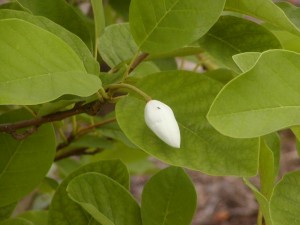
A friend on vacation sent me the attached photo from Wooster, Ohio. When I told him that it was Oyama magnolia (Magnolia sieboldii), he asked why gardeners are not growing it. Good question! Oyama magnolia is a 10-15 feet tall (and equal spread) deciduous tree or large shrub from eastern Asia. It prefers to grow […]
Posted in acidic soil, compost, Featured, Flowering, Large shrub, Magnolia, Magnolia sieboldii, mulching, Propagation (Cuttings), Pruning, Southern Appalachian Region, Spring flowering, Summer flowering, winter hardiness Comments Off on Summer Blooming Oyama Magnolia


