
For their sheer architecture alone, ornamental grasses provide 4- seasons of landscape excitement. Within a small garden space three mid-sized (4 – 6 feet tall) ornamental grasses with awesome vertical stature excel. All are highly rated for long garden life and low annual maintenance. ‘Karl Foerster’ Feather Reed Grass (Calamagrostis x acutiflora ) forms silvery […]
Archive for the ‘Perennials’ Category
Three Mid-sized Ornamental Grasses for Small Gardens
Posted by Hugh on April 14th, 2011
‘Misty Blue’ Doll’s Eye Will Catch Your Eye
Posted by Hugh on March 22nd, 2011
White baneberry or doll’s eye (Actaea pachypoda) is a strikingly beautiful native perennial. The cultivar ‘Misty Blue’ was first discovered at Mt. Cuba Center in Greenville, Delaware. The bluish-green foliage is multi-stemmed and finely cut from mid-spring thru the summer months. Grow it in a moist shade garden environment. Lovely fringed white flowers appear in April. In the fall clusters of white “doll’s eye” berry fruits sit atop brightly red […]
 Posted in acidic soil, Baneberry (Actaea), compost, Garden Maintenance, Native Plant, Perennials, Southern Appalachian Region, watering tips
  Comments Off on ‘Misty Blue’ Doll’s Eye Will Catch Your Eye
‘Jeana’ Phlox– no powdery mildew
Posted by Hugh on March 18th, 2011
Photo credit: North Creek Nurseries, Landenberg, PA, USA Our native summer phlox (Phlox paniculata) continues to be challenged here in the Southern Appalachian region (USDA zones 6 and 7) by powdery mildew disease (p-m-d). Over the past decade gardeners have tried new, reportedly disease resistant cultivars. Many have disappointed. To date, the cultivars ‘David’ (white, 3-4 […]
Posted in Disease resistant, Flowers, Native Plant, Perennials, Southern Appalachian Region, Summer phlox (P. paniculata) Comments Off on ‘Jeana’ Phlox– no powdery mildewPulmonarias: Wonderful In The Shade Garden
Posted by Hugh on March 6th, 2011
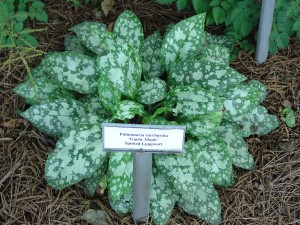
Although my multi-year addiction for hostas has never waned, I remain equally passionate about the lungworts (Pulmonaria spp.). Lungwort is also called Bethlehem sage and Jerusalem sage. Their uniquely splotched or variegated foliage wakes up a dark patch in any shade garden. Lungworts are planted as ground covers and for color accents. In early spring (March), lungworts send up […]
Posted in acidic soil, Container garden, Ground cover, Landscape ideas, mulching, Perennials, Planting tips, Propagation (dividing), Pulmonaria, Purchasing Plants, Shade Gardening, Soil drainage, Southern Appalachian Region, Spring flowering, Sun scald, watering tips, winter hardiness Comments Off on Pulmonarias: Wonderful In The Shade GardenThe Other Lenten Roses
Posted by Hugh on February 7th, 2011
In addition to the popular Oriental hellebore (H. x orientalis), four other species are hardy in the Southern Appalachian region (USDA hardiness zones 6 and 7). Christmas rose (H. niger) is the first lenten rose to bloom, often 4-6 weeks earlier if mild December weather permits. The 3 ½- inch flowers are large and showy, […]
Posted in alkaline soil, compost, Flowers, Lenten rose (Hellebore), mulching, Perennials, Shade Gardening, Southern Appalachian Region, watering tips, Winter Garden Interest, winter hardiness, Winter Protection Comments Off on The Other Lenten RosesLenten Roses Perk Up the February Garden
Posted by Hugh on February 2nd, 2011
Lenten roses or hellebores (Helleborus spp.) are long-lived perennials, often surviving in the same garden spot for many years. Four species of Lenten roses grow in the Southern Appalachian region (USDA hardiness zones 6 and 7). All thrive in shady garden recesses, exposed to as little as 3 – 4 hours of dappled sunlight. Numerous […]
Posted in alkaline soil, compost, Lenten rose (Hellebore), mulching, Perennials, Pruning, Shade Gardening, Southern Appalachian Region, watering tips, Winter Garden Interest Comments Off on Lenten Roses Perk Up the February Garden2012 Perennial Plant of the Year Named
Posted by Hugh on January 21st, 2011
The Perennial Plant Association (PPA) has selected Brunnera macrophylla ‘Jack Frost’ as the 2012 Perennial Plant of the Year. Runnersup for 2012 honors were Panicum virgatum ’Northwind’, Heuchera ‘Caramel’ and Chelone lyonii ‘Hot Lips’. Brunnera ‘Jack Frost’ foliage is deer resistant. It grows to a height and width of 12-15 inches. Its silvery foliage stands out in a […]
Posted in Brunnera 'Jack Frost', mulching, Perennials, Shade Gardening, Southern Appalachian Region, watering tips Comments Off on 2012 Perennial Plant of the Year Named“It’s Wort…not Wart”
Posted by Hugh on November 25th, 2010
Barrenworts (Epimedium spp.) are a collection of ground cover species mostly from Asia and Europe. None are native to North America, but most thrive in gardens in the Southern Appalachian region (USDA zones 6 and 7). There are currently 21 known species worldwide. Also called Bishop’s hat, barrenworts are one of our finest groundcovers for part sun to part shade areas. Some are […]
Posted in Barrenwort (Epimedium), Ground cover, Perennials, seeding lawn, Shade Gardening, Southern Appalachian Region, Uncategorized Comments Off on “It’s Wort…not Wart”Be Careful What You’re Cutting Back
Posted by Hugh on November 4th, 2010
Halfway through the autumn season, new plants have come to life, while most are retiring for a long winter’s nap (dormancy). About 4-5 weeks back, the leafy growth (vegetative) stage of the surprise lily (Lycoris radiata), also called “resurrection lily or “naked ladies”, appeared (left and center photos). When last seen in late July and August, brightly colored stalks of lycoris flowers had popped through with no leaves present. […]
Posted in acidic soil, compost, Flowering Bulb, Ground cover, Perennials, Shade Gardening 2 Comments »Arkansas Bluestar Great In Spring, Summer and Fall
Posted by Hugh on October 27th, 2010
Blue star (Amsonia hubrichtii) exhibits one of nature’s finest autumn foliar displays. This Arkansas native is a long-lived perennial and prospers here in the Southern Appalachian region (USDA zones 6 and 7). After its initial year in the garden, amsonia exhibits good heat and drought tolerances. Its fine textured needle -like foliage is very soft and airy. In the […]
Posted in Disease resistant, Drought tolerant, Heat Tolerance, Perennials, Planting tips, Pruning, Spring flowering, watering tips Comments Off on Arkansas Bluestar Great In Spring, Summer and Fall


