
Seven reasons why you prune: eliminate dead, diseased, insect riddled branches control plant height and spread shaping such as topiary, espaliered or pollardized trees increase or decrease the numbers of flowers and fruits rejuvenate an old shrub or tree remove low branches over walkways remove water sprouts and root suckers Flowering shrubs bloom from late February thru […]
Archive for the ‘Southern Appalachian Region’ Category
When To Prune Spring Flowering Shrubs
Posted by Hugh on March 25th, 2011
 Posted in Disease resistant, Failure to Bloom, Garden Maintenance, Pruning, shrub roses, Southern Appalachian Region, Trees & Shrubs
  Comments Off on When To Prune Spring Flowering Shrubs
‘Misty Blue’ Doll’s Eye Will Catch Your Eye
Posted by Hugh on March 22nd, 2011
White baneberry or doll’s eye (Actaea pachypoda) is a strikingly beautiful native perennial. The cultivar ‘Misty Blue’ was first discovered at Mt. Cuba Center in Greenville, Delaware. The bluish-green foliage is multi-stemmed and finely cut from mid-spring thru the summer months. Grow it in a moist shade garden environment. Lovely fringed white flowers appear in April. In the fall clusters of white “doll’s eye” berry fruits sit atop brightly red […]
Posted in acidic soil, Baneberry (Actaea), compost, Garden Maintenance, Native Plant, Perennials, Southern Appalachian Region, watering tips Comments Off on ‘Misty Blue’ Doll’s Eye Will Catch Your Eye‘Jeana’ Phlox– no powdery mildew
Posted by Hugh on March 18th, 2011
Photo credit: North Creek Nurseries, Landenberg, PA, USA Our native summer phlox (Phlox paniculata) continues to be challenged here in the Southern Appalachian region (USDA zones 6 and 7) by powdery mildew disease (p-m-d). Over the past decade gardeners have tried new, reportedly disease resistant cultivars. Many have disappointed. To date, the cultivars ‘David’ (white, 3-4 […]
Posted in Disease resistant, Flowers, Native Plant, Perennials, Southern Appalachian Region, Summer phlox (P. paniculata) Comments Off on ‘Jeana’ Phlox– no powdery mildewBetter Choices for Golden Moon Maple
Posted by Hugh on March 15th, 2011
Photo credit: Mr. Brian Upchurch, Highland Creek Nursery, Fletcher, NC A few months back I asked Mr. Brian Upchurch, owner of Highland Creek Nursery*, his opinion of Golden Fullmoon Japanese maple (Acer shirasawanum ‘Aureum’) in our Southern Appalachian region (USDA zones 6 and 7). He responded: “I have grown it in the past and it […]
Posted in Fullmoon maple, Japanese maple, Maples (Acer), Southern Appalachian Region, Summer heat tolerant Comments Off on Better Choices for Golden Moon MapleBlueberries
Posted by Hugh on March 12th, 2011

Blueberries (Vaccinium spp.) are healthy for you and exceptionally easy to grow organically (without pesticides). Why?- because blueberries are bothered by very few disease and insect problems. Success in growing blueberries depends upon pre-plant soil preparation. If you’re thinking about growing blueberrues for the first time, then allot this calendar year for soil preparation. Put off planting blueberries until the early fall or […]
Posted in acidify soil, Blueberries, compost, Featured, Fruits & Vegetables, organic gardening, Southern Appalachian Region Comments Off on BlueberriesAct Now for Crabgrass-free Lawn This Summer
Posted by Hugh on March 9th, 2011
What grows there? Hopefully, it’s not crabgrass this summer. Crabgrass (Digitaria spp.) is an annual weed grass that devour lawns, shrub beds and flower gardens. There are lots of effective crabgrass preventatives sold at garden shops, hardware stores, and farm supply centers. There are numerous trademarked products. It is important to read and understand package instructions. […]
Posted in Crabgrass control, Garden Problems, Lawn Care, Southern Appalachian Region  Tags: Lawn Care Comments Off on Act Now for Crabgrass-free Lawn This Summer
Pulmonarias: Wonderful In The Shade Garden
Posted by Hugh on March 6th, 2011
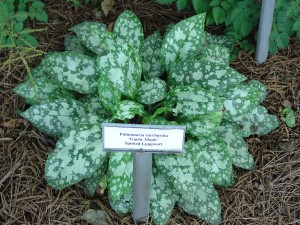
Although my multi-year addiction for hostas has never waned, I remain equally passionate about the lungworts (Pulmonaria spp.). Lungwort is also called Bethlehem sage and Jerusalem sage. Their uniquely splotched or variegated foliage wakes up a dark patch in any shade garden. Lungworts are planted as ground covers and for color accents. In early spring (March), lungworts send up […]
Posted in acidic soil, Container garden, Ground cover, Landscape ideas, mulching, Perennials, Planting tips, Propagation (dividing), Pulmonaria, Purchasing Plants, Shade Gardening, Soil drainage, Southern Appalachian Region, Spring flowering, Sun scald, watering tips, winter hardiness Comments Off on Pulmonarias: Wonderful In The Shade GardenPrune Some Hydrangeas Now
Posted by Hugh on March 3rd, 2011
PeeGee or panicled hydrangea (Hydrangea paniculata) and our native Smooth hydrangea (Hydrangea arborescens) are pruned now in late winter thru early spring. Why? – because these hydrangeas bloom on new or current season’s wood. Over the years these two hydrangea species grow to enormous sizes. When they overwhelm their garden space, severely cut them back to within 6 -12 inches from […]
Posted in Flowers, Garden Maintenance, Hydrangea, Hydrangeas, Pruning, Southern Appalachian Region, Trees & Shrubs Comments Off on Prune Some Hydrangeas NowWinter Jasmine Rising
Posted by Hugh on March 1st, 2011
Is the worst of winter behind us? Winter jasmine (Jasminum nudiflorum) is often confused with forsythia shrubs which bloom 3-4 weeks later in the spring. This hardy winter blooming vine from China frequently blooms in late February and March when daytime temperatures climb into the mid-50s for a week or more. Evening chilling temps down into the […]
‘Kintoki’ Japanese Cornel Is Perfect Fit for Small Urban Gardens
Posted by Hugh on February 27th, 2011
‘Kintoki’ summer foliage It’s a dogwood and comes close to being a plant that offers four seasons of landsape beauty. Kintoki Japanese cornel (Cornus officinalis ‘Kintoki’) is a special semi-dwarf 10-12 foot tall dogwood which fits into most small gardens. Kintoki’s bright yellow flowers open in early March in the Southern Appalachian region (USDA zones 6 and 7). […]
Posted in compact tree, Flowering, Japanese cornel, Southern Appalachian Region, Trees & Shrubs, winter flowering tree Comments Off on ‘Kintoki’ Japanese Cornel Is Perfect Fit for Small Urban Gardens


